|  |  |  | | | | | SeekingAlpha.com: Home Page | | | | | | | | | | | | | | | | | | | Kent Moors submits: The rising price of oil is prompting a broader debate over how to preserve as many power source options as possible. And it is beginning to provide a reprieve for one energy source under heavy pressure: Coal. Before the eruptions from MENA (the Middle East and North Africa), it was a foregone conclusion that coal would be declining as a fuel for power generation in the U.S. Certainly, coal-fired plants would not be disappearing completely in the near future … yet the balance was clearly swinging in favor of natural gas and even renewables. Most had expected that the battle over carbon capture and storage would be the watershed event marking the end of the coal industry. That fight is now delayed – but hardly forgotten – inside the D.C. beltway. What happened instead is the introduction of new non-carbon regulations, set to begin next January, for mercury, sulfurous, and
Complete Story » | | | | | | | | | | | | | | | | | | | | | | | | Rougemont submits: I'm writing this to counter some of the points made in the article written by David Alton Clark called "Why I'm Bullish on MEMC's ( WFR) Future," which you can read here. While I think Mr. Clark made a good case for MEMC, I think buying MEMC over the Chinese solars just because they are Chinese is just plain wrong, and here are the many reasons why: There is no doubt a double standard exists (for now) in how Chinese solar related stocks are valued compared to U.S. companies. Read my article about the double standard in solar valuations here. Energy Conversion Devices, ( ENER), Evergreen Solar ( ESLR) and other U.S. based solars are getting eaten alive by LDK Solar ( LDK) and other low-cost China based companies. ENER and ESLR both recently announced lousy financial results, which leads me to believe they won't be able to compete with the scale and low-cost
Complete Story » | | | | | | | | | | | | | | | | | | | | | | | | | Hard Assets Investor submits: By Brad Zigler Gold reversed course Thursday, along with a broad spectrum of commodities, paring the gains scored earlier against the reserve currencies. Still, bullion managed to eke out a 0.7 percent advance vs. the yen and moved ahead 0.6 percent against sterling. The Swiss franc gave up 0.2 percent to gold, while the euro gained 0.1 percent. U.S. dollar-denominated assets traded in a slightly inflationary direction this week. - On Thursday morning, London gold was fixed at $1,424, off 0.4 percent for the week; interim fixes averaged $1,429; spot metal settled at $1,412 on Comex, down 0.3 percent; average daily volume jumped 17.3 percent to 202,626 contracts; open interest picked up 2,424 contracts to finish at 521,137.
- Comex gold inventories fell by 48,737 ounces (1.5 tonnes) to 11.098 million; stocks now cover 21.3 percent of open interest; immediate demand for Comex bullion amounts to no more than 3,700 ounces, while
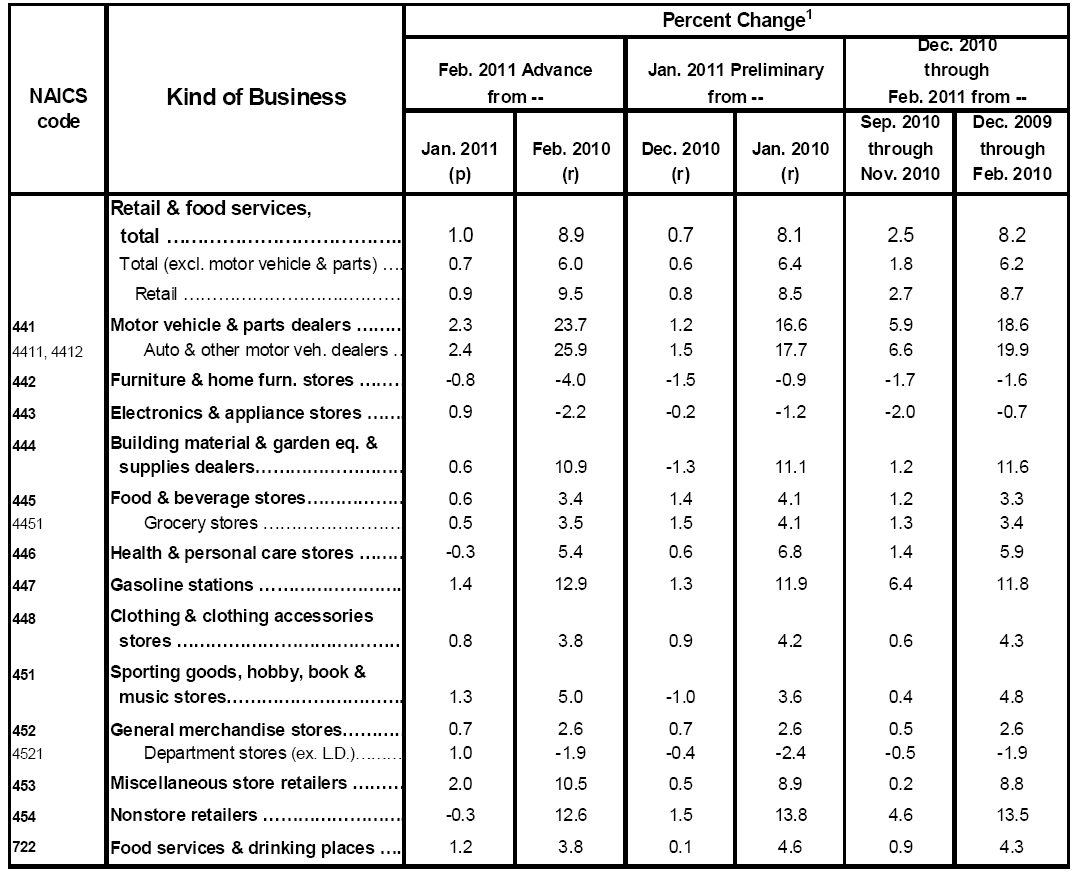
Complete Story » | | | | | | | | | | | | | | | | | | | | | | | | | James Picerno submits: Retail sales jumped 1% on a seasonally adjusted basis last month, the Census Bureau reports. That's the best monthly gain since last October's 1.6% surge. It's also the eighth straight monthly increase. Consumption, in other words, is doing fine. But quite a bit has changed on the global stage in recent weeks, namely, the Mideast turmoil and resulting jump in oil prices. The question is whether February data is dated? Once again, the waiting game is back in vogue. We can celebrate the recent pop in economic numbers, but there are fresh reasons to wonder if newly accelerated economic rebound is headed for rougher waters. It's premature to dismiss the revival in growth, but it's also short-sighted to ignore the mounting hazards. Even ignoring recent events, the case for expecting a slowing in the retail sales trend is plausible. Consider how consumption fares in recent history vs. industrial production and
Complete Story » | | | | | | | | | | | | | | | | | | | | | | | | | optionMONSTER submits: By David Russell Bullishness has been spreading among pre-paid cellular companies, and now they're targeting Leap Wireless. Our Heat Seeker tracking system detected the purchase of 3,500 July 15 calls for $1 and $1.05 and the sale of an equal number of July 13 puts for $1.45. Volume was more than 4 times open interest in both strikes. The trade resulted in a credit of about $0.45 and will earn theoretically infinite profits if the shares push higher, with the gains accelerating over $15. It will lose money below $12.55.
LEAP fell 4.99 percent to $13.01 in late morning trading. Yesterday it rallied more than 9 percent after a major shareholder said it was trying to shake up its board of directors. The investor, Pentwater Capital Management, said the company has mismanaged its cost structure and handset inventory. It also questioned LEAP's strategic focus on broadband services.
Pre-paid wireless carriers
Complete Story » | | | | | | | | | | | | | | | | | | | | | | | | | Morningstar submits: While it is easy to visualize what pharmaceutical firms or medical device firms produce, the life science segment seems a little hazier to investors. We do not encounter its products in daily life, nor do we usually see them in the doctor's office. Life science firms produce equipment and consumables (such as tests and reagents) for use in research, applied markets, and diagnostic labs. Research customers come from government and university laboratories as well as from the development arms of large pharmaceutical and biotechnology companies. Life science products also trickle down into the applied market for use in forensics, agriculture, and environmental testing. These firms also make products for molecular diagnostics to detect mutations or strains of viruses, like the H1N1 flu. While we don't currently have any 5-star calls in our life science coverage universe, we still view the market as attractive and have outlined our broad expectations for
Complete Story » | | | | | | | | | | | | | | | | | | | | | | | |  Hickey and Walters (Bespoke) submit: Hickey and Walters (Bespoke) submit: Last week the S&P 500 (SPY) and five of its sectors were trading in overbought territory. After a week of declines, the S&P 500 is now below its 50-day moving average, while two sectors are overbought and two are oversold. The two sectors that remain overbought are both defensive in nature -- Consumer Staples and Utilities. Technology and Materials are the two sectors that have moved into oversold territory. The Materials sector is the one that saw the biggest swing from positive to negative over the last week. It was very close to overbought territory last week, but now it is more than two standard deviations below its 50-day moving average.
So how does underlying breadth look? Below are charts for the S&P 500 and its ten sectors showing the percentage of stocks trading above their 50-day moving averages. In the S&P 500, 53% of stocks are currently trading above
Complete Story » | | | | | | | | | | | | | | | | | | | | | | | | | Andrew Wilkinson submits: Energy Select Sector SPDR ETF (XLE) – Options volume on the XLE jumped following the opening bell this morning, with most of the activity concentrated in April contract puts. It looks like one big player kicked things off in the first 20 minutes of the session by unraveling a massive bear put spread on the fund. Shares in the XLE rose sharply today, gaining as much as 1.95% in early afternoon-trade to hit $75.27 by 12:20pm. The trader responsible for the largest put spread print certainly seems to have a keen sense of timing, initiating the debit put spread near the XLE's top, and taking the spread down this morning ahead of the intraday move higher. The investor appears to have initiated the spread back on February 28, 2011, when shares in the XLE reached a session-high of $78.69. The big player sat with the trade, watching shares hit fresh
Complete Story » | | | | | | | | | | | | | | | | | | | | | | | | | Zacks.com submits: By Dirk van Dijk Retail Sales were in line with high expectations for February. Total retail sales rose 1.0%, and are up 8.9% from a year ago. January was revised up from 0.3% growth to 0.7% growth. That was a major positive surprise.
The Retail Sales report covers far more than just the shopping malls and is a very broad-based measure of consumer spending. Since consumer spending makes up 71% of the economy it is a very important number. That overstates things a bit since retail sales are mostly about the sale of goods, not services, and services make up two thirds of what consumers spend. Still, it is a pretty important thing to watch.
Auto sales were a bit of a help to overall retail sales in February, rising 2.3% on the month, after rising 1.2% in January (revised up significantly from 0.5%). On a year-over-year basis they were
Complete Story » | | | | | | | | | | | | | | | | | | | | | | | | | Pall (PLL) Q2 2011 Earnings Call March 11, 2011 8:30 am ET Executives Kenneth Frank - President of BioPharm Eric Krasnoff - Chairman, Chief Executive Officer, President and Chairman of Executive Committee Lisa McDermott - Chief Financial Officer and Treasurer Analysts Hamzah Mazari - Crédit Suisse AG Richard Eastman - Robert W. Baird & Co. Incorporated Jonathan Groberg - Macquarie Research Kevin Maczka - BB&T Capital Markets David Rose - Wedbush Securities Inc. Brian Drab - William Blair & Company L.L.C. Tracy Marshbanks Presentation Operator Welcome to Pall Corporation's Conference Call and Webcast for the Second Quarter for Fiscal 2011. [Operator Instructions] We'd like to remind you that the company's second quarter press release is available at www.pall.com. Management's remarks this morning will include forward-looking statements. Please refer to Slide 2 or request a copy of the specific wording of this qualification of the company's remarks. Management also uses certain
Complete Story » | | | | | | | | | | | | | | | | | | | | | | | | | Doug Short submits: The University of Michigan Consumer Sentiment Index preliminary report for March came in at 68.2, down from 77.5 in February and a stunning reversal from the recent trend of improving sentiment. The Briefing.com consensus expectation had been for 76.5 and Briefing.com's own forecast was for 78.0. The survey's measure of current economic conditions dropped to 83.6, from 86.9 the month before. Consumer expectations fell to 58.3 from 71.6, the lowest level since March 2009. Consumer inflation expectations rose to 4.6 percent from 3.4 percent in February, the highest since August 2008. The 5-10-year inflation outlook rose to 3.2 percent from 2.9 percent. The increase in gasoline prices was no doubt a factor. See the chart below for a long-term perspective on this widely watched index. Because the sentiment index has trended upward since its inception in 1978, I've added a linear regression to help understand the pattern of reversion to
Complete Story » | | | | | | | | | | | | | | | | | | | | | | | | | Nicholas Marshi submits: There has been much hullabaloo surrounding upper middle market Business Development Company ("BDC") BlackRock Kelso (BKCC) in the last couple of days. On Tuesday, March 8, at the opening, the company released its fourth quarter earnings report and its annual 10-K filing. After the market close came the conference call. In between the company's stock price dropped from $12.69 to close at $10.20. That's a 20% drop, and quite a move for a company that maintained its dividend for a sixth quarter in a row at $0.32. We've had a number of emails (OK, just two) here at the BDC Reporter asking about what's happening to BKCC, so we thought we would have a go at explaining the sudden state of disillusion with BlackRock Kelso. Of course when a stock drops sellers are not asked to sign a feed-back card as to why they're getting out (note to the SEC:
Complete Story » | | | | | | | | | | | | | | | | | | | | | | | | | The LFB submits: Global commodity markets are holding lower, after price action moves this week saw profit-taking of recent gains that had paid strong dividends over the course of 2011 in the precious metal and oil markets. Banking of profits should not be confused with the building of long-term short positions, as recent moves are not as yet providing any signals to indicate that a new short mid-term trend will be sustainable.
Patience is key at times when global markets reverse off tests of yearly highs, and attention should be paid to the strength of trend on the longer-term timeframe charts. Recent moves to test support are likely to be bought in the near-term on precious metals and oil trade.
The Sentiment and Momentum Indicator alert to get short the gold bullion market, with a break of 1422 eventually hit its downside target at 1411, and that position should now be closed. Price
Complete Story » | | | | | | | | | | | | | | | | | | | | | | | | | Cullen Roche submits: I've spent quite a bit of time here discussing the excesses in China and the extraordinarily flawed monetary policy that China has maintained over the last few years. In a recent piece, Barry Eichengren of UC Berkeley succinctly expanded on this theme and concluded that a Chinese slow-down is "imminent." Eichengren says there are three primary reasons why we should expect a slow-down: - "Slowdowns are also more likely in countries where the manufacturing sector's share of employment exceeds 20%, since it then becomes necessary to shift workers into services, where productivity growth is slower. This, too, is now China's situation, reflecting past success in expanding its manufacturing base."
- "Most strikingly, slowdowns come earlier in economies with undervalued currencies. One reason is that countries relying on undervalued exchange rates are more vulnerable to external shocks. Moreover, while currency undervaluation may work well as a mechanism for boosting growth in the early
Complete Story » | | | | | | | | | | | | | | | | | | | | | | | | | Equitymaster submits: After opening below the dotted line, the Indian stock market indices witnessed some momentum in the morning session. However, with the earthquake in Japan and sustained worries over crude and food prices, stocks moved further into negative territory. While the BSE-Sensex closed 154 points lower (a 0.8% decline), the NSE-Nifty closed lower by 49 points (down 0.9%). The BSE Midcap and the BSE Small cap indices, however were worse off. They were both trading over 1% lower. Regarding the sectoral indices, metal and IT stocks saw declines. However oil and gas stocks did see some gains, while FMCG stocks remained flat. As regards major global stock markets, all Asian indices were trading in the negative zone. The 8.9 magnitude earthquake and the subsequent tsunami in Japan sent stocks plummeting in the region. The Japanese stock market was the worst hit, falling 1.7%. All European indices also opened in the red.
Complete Story » | | | | | | | | | | | | | | | | | | | | | | | | | Hickey and Walters (Bespoke) submit: Following today's massive earthquake that hit Japan, a number of clients have asked us how the Japanese stock market performed following the destructive Kobe earthquake that hit the country on January 17, 1995. While the impact on Japan from the two quakes will surely be different, the Nikkei-225 got hit pretty hard
Complete Story » | | | | | | | | | | | | | | | | | | | | | | | | | Stone Fox Capital submits: Most investors continue to focus on high dividend yielding stocks paying very little attention to stock buybacks. Unless you're a retiree living completely on fixed income, it's a mistake to not focus on the complete picture of returns of capital to shareholders. The combination of stock buybacks and dividends or Net Payout Yields (NPY) has offered higher returns in the past.
Buybacks can be a more efficient return of capital to shareholders as it reduces the tax burden of investors. Management also has more flexibility to increase the payout ratio when a company's stock fluctuates in price. With dividends, the investment culture requires a steady-to-rising dividend stream - leaving management teams stuck with low payout ratios to allow for unforeseen events that could lower corporate profits or liquidity.
Below is a list of stocks with the top NPY with market caps above $10B as of the 10th. As can be
Complete Story » | | | | | | | | | | | | | | | | | | | | | | | | | Zacks.com submits: Leading medical devices player Medtronic (MDT) has strengthened its spinal business with the launch of two products – Vertex Select Chromaloy Plus Rods and the Atlantis Vision Elite Anterior cervical plate system. The former is a supplement to the Vertex Select reconstruction system, which is meant to treat patients suffering from several conditions such as degenerative disc disease, spinal stenosis, fracture, tumors, and/or spondylolisthesis. The Atlantis Vision Elite Anterior cervical plate system is used to treat patients who suffer from degenerative disc disease that affects the neck (cervical spine). There is immense market potential in this area, as it is estimated that 180,000 cervical fusion procedures are performed in the U.S. each year to relieve compression on the spinal cord or nerve roots. The latest product in the Atlantis franchisee is designed to provide stability during spinal fusion, a procedure that joins two bones together. The good news surrounding the
Complete Story » | | | | | | | | | | | | | | | | | | | | | | | | | Oil-Dri of America (ODC) Q2 2011 Earnings Call March 11, 2011 10:00 am ET Executives Jeffrey Libert - Chief Financial Officer, Vice President and Treasurer Ronda Williams - IR Daniel Jaffee - Chief Executive Officer, President, Director and Member of Executive Committee Analysts Robert Smith - The Center for Performance Ethan Starr - Private Investor Brad Evans - Heartland Presentation Operator Good day, ladies and gentlemen, and welcome to the Second Quarter 2011 Oil-Dri Corporation of America Earnings Conference Call. My name is Francine, and I am your operator for today. [Operator Instructions] I would now like to turn the presentation over to your host for today's call, Mr. Dan Jaffee, President and Chief Executive Officer. Please proceed. Daniel Jaffee Thank you. Welcome everybody to the second quarter and six months teleconference. With me in the conference room is Doug Graham, our Vice President and General Counsel; Dan Smith, our
Complete Story » | | | | | | | | | | | | | | | | | | | | | | | | | David Hunkar submits: Last December I wrote an article on U.S. companies with high exposure to emerging markets. Now let's take a look at foreign firms that have high exposure to the U.S. market. Despite sluggish economic growth, the U.S. remains the world's largest consumer market and is the world's top destination for foreign direct investment (FDI). Hence hundreds of foreign firms have operations in the U.S. to take advantage of this huge market. This process of foreign companies investing in the U.S. and creating jobs is called "Insourcing." During the last decade, FDI in the United States jumped by 82% from $179 billion to over $325 billion, resulting in the insourcing of 5.3 million American jobs, or 4.6% of the U.S. workforce. While most U.S. companies' offshore work consists of chasing the cheapest labor available on the planet (even if the quality is poor), it is commendable that some foreign firms actually
Complete Story » | | | | | | | | | | | | | | | | | | | | | | | | | UTStarcom Inc. (UTSI) Q4 2010 Earnings Call March 11, 2011 8:00 am ET Executives Jack Lu - CEO Edmond Cheng - CFO Analysts Jie Liu - Auriga USA Richard Greenburg - Donald Smith & Co. Presentation Operator Thank you for standing by for the UTStarcom's fourth quarter and full year 2010 earnings conference call. (Operator Instructions) It is now my pleasure to introduce your host, Jing Ou-Yang, Investor Relations for UTStarcom. Jing Ou-Yang Welcome to UTStarcom's fourth quarter 2010 earnings conference call. We distributed our earnings press release earlier today, and you can find a copy on Newswire Services or on our website at www.utstar.com. In addition, we have posted a presentation on our website which you can download to use to follow along with today's call. On today's call, we have Mr. Jack Lu, our President and CEO; and Mr. Edmond Cheng, our CFO. Before we get started, I
Complete Story » | | | | | | | | | | | | | | | | | | | | | | | | | YCharts.com submits: Can CVS Caremark Corp's (CVS) promise of rising dividends and share buybacks make up for its seemingly interminable struggles with a four-year-old acquisition? It hasn't so far. Investors clearly are fed up with the drug store company's inability to properly integrate Caremark, a pharmacy benefits management company it purchased for $21 billion in 2007. Last month's announcement of disappointing annual CVS earnings – held down once again by Caremark – led to familiar post-results selling in the shares.
But these shares are undervalued, according to YCharts Pro. In fact, our Large Cap Value model shows CVS, market cap about $45 billion, as one of the most attractive of the major shares today. Management's plans to fork over a lot of cash to shareholders over the next five years, plus signs of improvement at Caremark, lead us to agree.
CVS's store chain, which with 7,000 outlets is second only to Walgreens
Complete Story » | | | | | | | | | | | | | | | | | | | | | | | | | AnnTaylor Stores (ANN) Q4 2010 Earnings Call March 11, 2011 8:30 am ET Executives Judith Lord - Michael Nicholson - Chief Financial Officer, Principal Accounting Officer, Executive Vice President and Treasurer Katherine Krill - Chief Executive Officer, President and Executive Director Analysts Jeff Black - Citigroup Inc Adrienne Tennant - Janney Montgomery Scott LLC Linda Tsai - MKM Partners LLC Paul Lejuez - Credit Suisse Roxanne Meyer - UBS Investment Bank Janet Kloppenburg - JJK Research Presentation Operator Good morning, ladies and gentlemen, and welcome to Ann Taylor Stores Corporation's Fourth Quarter 2010 Earnings Conference Call. [Operator Instructions] I would now like to turn the call over to Judy Lord, Vice President, Investor Relations. Please go ahead. Judith Lord Thank you, Caroline, and good morning, everyone. We're very pleased you could join us to review our results for the quarter and fiscal year 2010. I'm here today with Kay Krill,
Complete Story » | | | | | | | | | | | | | | | | | | | | | | | | | BioScrip (BIOS) Q4 2010 Earnings Call March 11, 2011 8:30 am ET Executives Mary Graves - Interim Chief Financial Officer and Treasurer Richard Smith - Chief Executive Officer, President, Chief Operating Officer and Director Lisa Wilson - In-Site Communications, IR Analysts Glenn Garmont - ThinkEquity LLC Wayne Anglace Michael Petusky - Noble Financial Group, Inc. Brooks O'Neil - Dougherty & Company LLC Presentation Operator Ladies and gentlemen, thank you for standing by, and welcome to the BioScrip 2011 (sic) [2010] Fourth Quarter and Year End Conference Call. [Operator Instructions] It is now my pleasure to turn the conference over to Ms. Lisa Wilson, Investor Relations for BioScrip. Please go ahead. Lisa Wilson Good morning, and thank you for joining us today for our 2010 fourth quarter and year end results conference call. By now you should have received a copy of our press release issued this morning. If you have
Complete Story » | | | | | | | | | | | | | | | | | | | | | | | | | optionMONSTER submits: By David Russell General Mills has been marking time since early 2010, but one investor is betting that 2011 will be a good year for the company. optionMONSTER's Heat Seeker tracking system detected a surge of call volume in the food stock, which has long been a favorite among consumer staples but suffered recently from high commodity prices. Activity focused on the April 38 contracts, with more than 10,000 were sold for $0.57, and the January 42.50s, where a block of 12,892 was purchased for $0.64. Volume was below open interest in the shorter-dated calls, suggesting that a long position was rolled nine months ahead. The transaction cost a net $242,890, or about $0.19 per new contract now owned. GIS fell 1.09 percent to $37.04 yesterday. It's up almost 4 percent in the last month in contrast to a 2 percent drop for the S&P 500, suggesting that its long
Complete Story » | | | | | | | | | | | | | | | | | | | | | | | | | Investment Underground submits: David Einhorn of Greenlight Capital is one of the most respected hedge fund investors today. Below are 6 companies he currently owns, plus some commentary on each. Broadridge Financial Solutions (BR): BR provides investor communication, securities processing and clearing and outsourcing solutions to the financial services industry. The company has a $2.8 billion dollar market cap, strong cash flows, a 2.7% dividend yield and a near monopoly in the proxy voting business. According to data provided by GuruFocus, Einhorn added positions in the $21 range, a good indicator that there is still value in BR at $21.55 per share, the price at the time of writing. Potash Corporation of Saskatchewan (POT): The eponymous producer of the fertilizer input, PotashCorp, maintains its number one position globally in the potash game. If you listen to the analysts over at UBS, which as with all analysts we would caution you to do with
Complete Story » | | | | | | | | | | | | | | | | | | | | | | | | | Insider Monkey submits: Clint Carlson is the founder, president and CIO of Carlson Capital, which reported $4.8 Billion total assets in its last 13F filing. Carlson holds a bachelor's degree and an M.B.A. from Rice University, and a Doctorate of Law degree from the University of Houston. Prior to forming Carlson Capital in 1993, Carlson was the head of risk arbitrage for the investment arm of the Bass Brothers organization. Carlson Capital's primary investment strategies include risk arbitrage, relative value arbitrage and distressed/credit arbitrage. Carlson managed approximately $6 billion across five hedge funds, including two multi-strategy and three single strategy funds as of December 31, 2010. Carlson Capital's biggest fund, the $3.86 billion Double Black Diamond LP, was founded in 1997. The fund gained an annualized 11 percent until 2009. In 2008 McKinsey`s Ron Hulme joined Carlson Capital as CEO. Hulme was employed for 26 years with McKinsey & Co. before taking the
Complete Story » | | | | | | | | | | | | | | | | | | | | | | | | | Jason Napodano submits: Phase 2 FV-100 Data Show Potential In December 2010, Inhibitex (INHX) announced results from the company's Phase 2 trial studying FV-100 as a treatment for herpes zoster, commonly known as shingles. The trial was a well-controlled, double-blind, clinical trial evaluating FV-100 against an active control of Glaxo's (GSK) Valtrex (valacyclovir). Roughly 350 patients, aged 50 years and older, were randomized to one of three treatment arms: 200 mg FV-100 administered once daily; 400 mg FV-100 administered once daily; and 1,000 mg valacyclovir administered three times per day. The primary endpoint of the study was a reduction in herpes zoster associated pain and severity as measured by the Zoster burden of illness (BOI) scale after 30 days of treatment. Secondary endpoints included the BOI after 90 days, incidence of post herpetic neuralgia (PHN), mean time to lesion crusting and healing, and use of concomitant pain medications.
Complete Story » | | | | | | | | | | | | | | | | | | | | | | | | | Neal Razi submits: Just wanted to write a follow up to my article on January's retail sales report. Last month saw a drop in several discretionary categories, such as building materials (explained away by weather), furniture, hobby goods and the always cyclically sensitive restaurants. I was concerned that the rising amounts of money being allocated to gasoline and food were eating into other, less critical, expenditures. Had this proven to be the case this month, it might have meant changing around investments away from cyclically sensitive consumer stocks. I am quite excited to report that, for this month at least, my concerns have proven to be false. Take a look:
Click to enlarge
Despite gasoline sales rising another 1.4%, and food sales rising 0.6% this month, many of those categories I was concerned about last time have improved. Restaurants, a nice indicator of consumer discretionary spending, rose 1.2%. Hobbies rose 1.3%, and building
Complete Story » | | | | | | | | | | | | | | | | | | | | | | | | | Kapitall submits: Below is a list of three biotech stocks that are oversold, with RSI (14) below 40. These three stocks have also seen, on average, more insider buying than insider selling over the last two years (excluding exercised options). For each company we'll list the average number of shares purchased by insiders on the open market over the last two years. Insiders seem to be enthusiastic about the prospects of their employers. Do they know something we don't? Full details below. Insider data sourced from Fidelity, RSI and all other data sourced from Finviz. Interactive Chart: Press Play to compare changes in analyst ratings over the last two years for the stocks mentioned below. Analyst ratings sourced from Zacks Investment Research. Note: The numbers on top of items represent the forward P/E ratio, if available. Your browser does not support iframes.
List sorted by avg. insider shares purchased.1. Seattle Genetics
Complete Story » | | | | | | | | | | | | | | | | | | | | | | | | | YCharts.com submits: Thermo Fisher Scientific Inc., (TMO), the nation's biggest laboratory supply company, reliably churns out cash in good times and bad.
At the same time that Thermo profit were under a bit of pressure from the economy's meltdown, the Massachusetts, company used its impressive free cash flow to go on a shopping spree over the past couple years.
It paid a combined $1.25 billion to snap up about a dozen smaller companies. Then in December it announced a richly priced $2.1 billion cash deal for California instrument maker Dionex (DNEX). Thermo also spent a billion dollars last year buying back its own shares, and has authorization to spend a bit more on Thermo buybacks again this year. Despite all the money going out the door, both major credit rating concerns recently bumped the company's investment-grade debt a notch higher. And Thermo's PE ratio, after slumming for a while in the wake
Complete Story » | | | | | | | | | | | | | | | | | | | | | | | |  David Merkel submits: David Merkel submits: I was pleasantly surprised by this book. Given the nature of the authors, for McKinsey & Company, I was predisposed to dislike it. But I liked it. What is the value of a corporation? It is the value of the free cash flows discounted at the cost of capital. That's basic. And yet, they unpack this simplicity into basic elements, without going overboard into a ton of detail. Value derives from: - Return on invested capital
- Revenue growth
- Cost of capital
But value does not derive from growth in EPS. I think that Peter Lynch brainwashed a lot of investors, and made them think that growth in EPS is everything. What this book suggests is a need to unpack accounting statements to get a sense of whether value is being created or not. Following the income statement is not enough; reviewing the level of accruals on the balance sheet helps a
Complete Story » | | | | | | | | | | | | | | | | | | | | | | | | | Wade Slome submits: All investors are optimistic, every time they open up a position, but just like surgeons, sometimes the outcome doesn't turn out as well as initially anticipated. When it comes to investing, I think this old Hindu proverb puts things into perspective: "No physician is really good before he has killed one or two patients." So too, an investor does not become really good until he kills off some investment positions. But like surgeons, investors also have to understand the most important aspect of tragic events is learning from them. In many cases, unexpected outcomes are out of our control and cannot be prevented. This conclusion, in and of itself, can provide valuable insights. But on many occasions, there are procedures, processes, and facts that were missed or botched, and learning from those mistakes can prove invaluable when it comes to refining the process in the future – in order to
Complete Story » | | | | | | | | | | | | | | | | | | | | | | | | | Above Average Odds Investing submits: Equal Energy (EQU) is an obscure, under-appreciated micro-cap turnaround that possesses both a large margin of safety and what we believe is an incredibly favorable, highly skewed risk/reward equation. Investment Highlights: An investment in Equal at or around the current price possesses nearly all the qualities we look for in a great investment. In particular: - A sustainable low valuation (both absolute and relative to peers).
- A good, incentivized management team.
- Near- to medium-term operating momentum.
- An attractive, value-centric long-term business model.
- Multiple internal and external high probability catalysts (which we expect will drive substantial near to medium-term upside).
- A situation where a variety of temporary issues converge to mask what we believe has been an impressive transformation in the company's core business and future prospects.
Other attractive attributes of EQU include: - Stable and highly visible revenue and cash flow stream.
- Improving economics from an attractive asset base in well explored
Complete Story » | | | | | | | | | | | | | | | | | | | | | | | | | Ironman at Political Calculations submits: Tyler Cowen links to our post looking at the change in the number of people employed at $7.25 in both 2006 and 2010 and asks: How much is the minimum wage at fault?
Let's see what we can see, shall we? First, let's look at the nominal and inflation-adjusted level of the U.S. federal minimum wage from 2006 through 2010, because that will give us a sense of how steep the minimum wage increases that took place over that time were in real terms: (Click charts to expand) Now, let's look at the numbers of people earning both the nominal federal minimum wage and the inflation-adjusted equivalent, along with the number of people actually counted by the Bureau of Labor Statistics as earning the nominal federal minimum wage changed for each year from 2006 through 2010. But wait! Just looking at these figures is ignoring the elephant in the room
Complete Story » | | | | | | | | | | | | | | | | | | | | | | | | | Stockerblog submits: Now that oil is over $100 a barrel, income investors are taking a closer look at oil and gas income investments. Several options are available. First, there are the stocks of the multinational oil companies, such as Exxon Mobil Corp. (XOM) with a 2.1% yield and ConocoPhillips (COP), which has a 3.3% yield. But there are other investment instruments, including oil income royalty trusts, oil master limited partnerships also known as MLPs, and one example of a publicly traded Limited Liability Company or LLC. Income from trusts and MLPs avoid double taxation; virtually all earnings are passed through to the shareholders without being taxed at the company level. The royalty trusts have several advantages over the partnerships. Limited partnerships don't send out 1099 forms, they send out a Schedule K-1 Form, and the income is reported on your tax return differently from regular dividends, with additional forms and preparation time
Complete Story » | | | | | | | | | | | | | | | | | | | | | | | | | A company's board of directors is often a big consideration when investment decisions are being made. In fact, there is at least one investment fund that focuses solely on utilizing metrics centered on effective governance in seeking to realize returns and gains from publicly traded companies. So how does the world's top ranking athletic products firm fare in the realm of good governance? Is the company's board as nimble and high quality as the shoes they sell? Let's find out. Nike's ( NKE) board of directors has 13 members. Slightly on the high side given that the average for companies of comparable size is 11. Nevertheless there are some advantages of having a considerable board. These include having a greater pool of experience and ideas to bring to the table and hopefully the opportunity for more diversity. According to Nike's corporate governance guidelines the company has a director retirement age of
Complete Story » | | | | | | | | | | | | | | | | | | | | | | | | | John Petersen submits: With their earnings call scheduled for later today I wanted to create a record of the issues that scare me about Ener1's (HEV) financial statements. I've spent a good deal of time going back and forth on this Instablog because I could be fretting over nothing and certainly don't want to yell fire in a crowded theater. I guess we'll know more after Ener1's earnings release this afternoon.
The source of my nightmares is battles with auditors and the SEC that I've fought in the past and lost. The short list of issues that I see are:
1. When Ener1 bought the last 19.5% of EnerDel from Delphi (DPGYF.PK), it was a stock for assets transaction that was valued at $32 million for accounting purposes. Since the hard assets of EnerDel already showed up on Ener1's balance sheet with a historical value in the $6 million range, the entire $32
Complete Story » | | | | | | | | | | | | | | | | | | | | | | | | | John M. Mason submits: From the Wall Street Journal this morning (Families Slice Debt to Lowest in 6 Years): "U.S. families—by defaulting on their loans and scrimping on expenses—shouldered a smaller debt burden in 2010 than at any point in the previous six years, putting them in position to start spending more. Total U.S. household debt, including mortgages and credit cards, fell for the second straight year in 2010 to $13.4 trillion, the Federal Reserve reported Thursday. That came to 116% of disposable income, down from a peak debt burden of 130% in 2007, and the lowest level since the fourth quarter of 2004." The logic in this is that people reduce debt so that they can spend more. I think that is called a non sequitur. If people (and businesses) get more and more in debt over a fifty year period (as they have since 1960) and this contributes to the worst recession
Complete Story » | | | | | | | | | | | | | | | | | | | | | | | | | Frank Voisin submits: In November, I wrote about H&R Block (HRB). The company has rebounded nicely since then, up more than 40%. The company announced a blockbuster quarter this week, showing that Mr. Market's concerns over the company's ability to compete without its RALs were misplaced. Tax season to-date results through Feb. 28: - Total tax returns prepared grow 6.0 percent.
- Total retail returns prepared up 3.2 percent.
- Total online returns prepared increase more than 30 percent; total digital returns up nearly 13 percent.
- Net retail-office tax preparation fees through Feb. 28 decline 4.1 percent; improving from down 7.6 percent at Feb. 15.
Fiscal Third Quarter results ended Jan. 31: - Industry-wide slow start to tax season contributes to 8.9 percent decline in third quarter revenues to $851.5 million.
- Net loss from continuing operations of $0.01 per share.
- Adjusted non-GAAP third quarter net income from continuing operations of $44.0 million, or $0.14 per share, compared
Complete Story » | | | | | | | | | | | | | | | | | | | | | | | |  Roger Nusbaum submits: Roger Nusbaum submits: Schwab (SCHW) has published an ETF Select List of what it describes as the best fund choices for 50 categories. While there is a little utility, for the most part it is worthless. The list seems to be targeted at an Investing 101 or maybe Investing 102 audience. Most of the equity categories are broad, so in choosing the best funds for each broad category, many of the funds are from Schwab and a bunch more are from Vanguard. I'm not critical of the fact that so many Schwab funds are the best pick. I heard an interview on CNBC about this earlier in the week, and one of the stated purposes here is to provide the best choices for Schwab customers. The expense ratios of Schwab's funds are very competitive and there is no commission to trade them at Schwab. In that light -- where each ETF provider has,
Complete Story » | | | | | | | | | | | | | | | | | | | | | | | | | Market Blog submits: Japan's biggest earthquake in 140 years has pushed global stocks and commodities markets lower. But guess what's up? The yen. The Japanese currency took a brief dip but then quickly turned higher against all 16 of its major counterparts. The reason? It still has safe-haven status, and there is speculation that overseas Japanese are repatriating large amounts of the currency. The Bank of Japan has also promised to do its utmost to support the financial markets. That could spark inflation -- which, in Japan, could actually be a healthy outcome. The yen appreciated 0.9 percent to 82.23 per U.S. dollar, and jumped as much as 1.1 percent, the most since Feb. 24. It earlier fell as much as 0.4 percent to 83.30, its weakest since Feb. 22. Meanwhile, the stock market has already earmarked the potential losers from the earthquake: the world's biggest reinsurance companies. Swiss Re (SWCEY.PK), Munich Re
Complete Story » | | | | | | | | | | | | | | | | | | | | | | | | | Stookle submits: The following is the list of securities that were bullish during the past five trading days, these stocks remained bullish in a turbulent macro economic environment. NYSE lost 2.2% during this period but these securities significantly outperformed the index. Most of these securities made higher highs in the time frame defying the broader market trend.
(Click to enlarge) Interactive chart
TRC Companies (TRR) istrading above its 50 day and 200day moving averages. The book value of TRC Companies Inc. is $1.58. TRR is currently trading at $4.98. Blue Square Israel (BSI) is trading above its 50 day and 200 day moving averages, with a ROE of 6.60% and a ROA of 2.99%. Book value of Alon Holdings Blue Square –Israel Ltd, is $4.90 and stock is trading at $10.13. Acorn International (ATV) is trading below its 50day moving average and above its 200 day moving average. Book value of Acorn
Complete Story » | | | | | | | | | | | | | | | | | | | | | | | | Terence Kennelly submits:I remember the first time I laid eyes on Builders FirstSource ( BLDR). It was trading in the 20s and had sales of over $2 billion, a star among the building supplies stocks. Its growth was strong since its IPO in 2005, bolstered by the robust housing market, and it was one of the southeast region's leading building suppliers. That was in 2006. Then came the housing meltdown, the global financial crisis and a precipitous fall to the bottom which occurred for BLDR in the spring of 2009 when the stock went below $1. The stock rebounded in 2010 only to sink to a low of $1.43 late in the year. With its fortunes tied to the southeastern housing market and the overall U.S. economy, BLDR is certainly a risky play going forward but one worth taking a look at for the long-term investor. Click to enlarge For a company that
Complete Story » | | | | | | | | | | | | | | | | | | | | | | | | | Marc Chandler submits: There are two main features in the foreign exchange market as North American participants return to close out the week. The first is a continued recovery of the U.S. dollar in a backdrop of widening peripheral European bond spreads, the continued reversal of the global equity market rally and the ongoing MENA tensions, and within the context of market positioning that has amassed a sizeable short dollar position in recent weeks, judging from the IMM data, the dollar's steady decline and proprietary information. The second feature is the strength of the Japanese yen in the wake of an earthquake that may have been near 9.0 on the Richter scale. The typical expectation, based on past experience, is for Japanese investors to repatriate funds. This, of course, was very unlike the market response to the recent earthquake in New Zealand, when the local dollar was sold off. Key differences: Japan's net
Complete Story » | | | | | | | | | | | | | | | | | | | | | | | | | Tate Dwinnell submits: Clean Energy Fuels (CLNE) continues to show signs that a long-term bottom is in place and will get another surge at the open this morning after the company beat analysts estimates on both the top and bottom line. The company posted a non-GAAP EPS of $0.17/share on revenues of $83 million which was better than the analyst estimates for $0.16/share in EPS on revenues of $70 million. It's the first quarter of profitability for the company since the year-ago quarter and represents a huge increase over the year ago quarter of 850% (EPS) and 97% (revenue). CEO Andrew Littlefair commented: Reflecting back on 2010, not only do we see positive momentum in our fuel sales trends, but I am extremely pleased with the build out of our operations, which now includes Northstar's liquefied-natural gas fueling system capabilities, IMW's global compressor operations, as well as BAF's enhanced vehicle conversion business. With
Complete Story » | | | | | | | | | | | | | | | | | | | | | | | | | NakedValue submits: Large U.S. banks like Bank of America (BAC), Citigroup (C), JP Morgan (JPM), PNC Financial (PNC) and Wells Fargo (WFC) have rallied significantly from March 2009 lows. Many investors may be interested in buying into the banks, but are reluctant to do so at current levels. There may, however, be a way to gain exposure to these banks with reasonably-priced leverage and hidden value. Hidden Value - The TARP warrants' exercise prices have anti-dilutive features to protect against cash dividends. Each warrant's dividend adjustment threshold is different. This offers potentially huge value to warrant holders over the lives of these long-dated derivatives.
Reasons to Be Cautious - Underlying stock price matters. Buying warrants because implied volatility is less than peers or because the dividend anti-dilution feature is undervalued can lead to significant gains, but you ultimately have to be bullish on the stocks before you can be bullish on the warrants. Stock
Complete Story » | | | | | | | | | | | | | | | | | | | | | | | | Steven Breazzano submits:"For most of the postwar era, the pharmaceutical industry has been the most profitable sector of the U.S. economy by virtually any performance measure (return on equity, return on sales, etc.). This superior performance was based on four structural pillars: (1) latitude to charge relatively high prices, (2) long product life cycles, (3) 'blockbuster' drugs, and (4) relatively high R&D productivity."
The above quote from Prof. Gary Pisano's book "Science Business" concisely sums up the sector and dives straight into the fundamental issues of the pharmaceutical business. However, as investors in big pharma over the last decade know, this success has not continued. Currently, Pfizer's (PFE), Eli Lilly's(LLY), Merck's(MRK), and Bristol Myers Squibb's (BMY) stock is trading at half of their value 10 years ago and GlaxoSmithKline (GSK) is faring slightly better at a negative 25%. This is in stark contrast to a 15% increase in the S&P 500 over
Complete Story » | | | | | | | | | | | | | | | | | | | | | | | | Zacks.com submits: We recently upgraded our recommendation on J. C. Penney Company Inc. ( JCP) to Outperform encouraged by better-than-expected fourth quarter 2010 results. Earlier, we had a Neutral rating on the company, which is one of the leading retailers of apparel and footwear, accessories, fashion jewelry, beauty products and home furnishings.Quarterly earnings of $1.23 per share handily beat the Zacks Consensus Estimate of $1.07, and shot up 20.6% from $1.02 earned in the prior-year quarter. Total sales of $5,703 million also came ahead of the Zacks Consensus Estimate of $5,638 million, and rose 2.8% from the year-ago quarter. Management had expected sales growth between 1.5% and 2.5% for the quarter. Comparable-store sales jumped 4.5% during the quarter, beating management's own target of 3% to 4% growth.J. C. Penney'saddition of 'Liz Claiborne', 'MNG by Mango' and 'Call it Spring' brands to its portfolio helped drive sales and improve traffic. J. C. Penney's
Complete Story » | | | | | | | | | | | | | | | | | | | | | | | | | Matteo Radaelli submits: Here are our estimates on next week's U.S. economic data:
NY Empire Manufacturing index (Tuesday 15th), Philadelphia Fed (Thursday 17th) – Both the NY Empire manufacturing index and the Philadelphia Fed rose in February – from 11.9 to 15.4 and from 19.3 to 35.9 respectively – confirming that the industrial sector outlook remains positive in the short term. Our estimate is for both the indices to continue to indicate a continuance of the positive trend in the industrial sector in the next few months thanks to the positive momentum in the global economy. However while we expect the NY Empire manufacturing index to extend the last few months' positive trend, rising to 16.5, we expect the Philadelphia Fed to correct to 29 following the strong increase in February. Surging oil prices are likely to have a limited impact on business morale in the short term, but should the oil price
Complete Story » | | | | | | | | | |  | |  | |  |




No comments:
Post a Comment