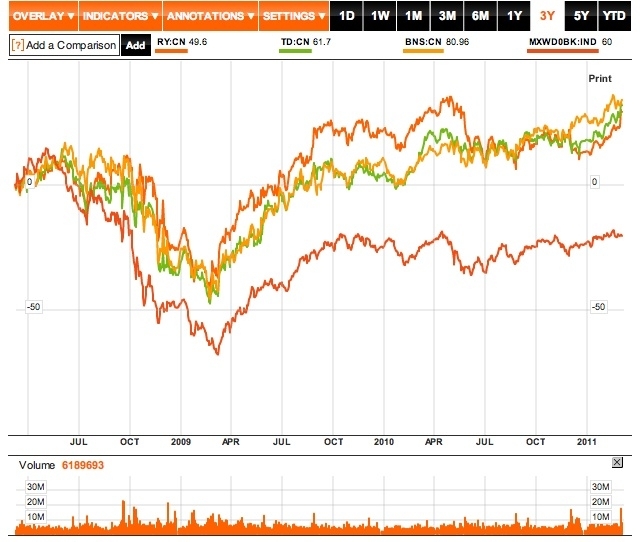
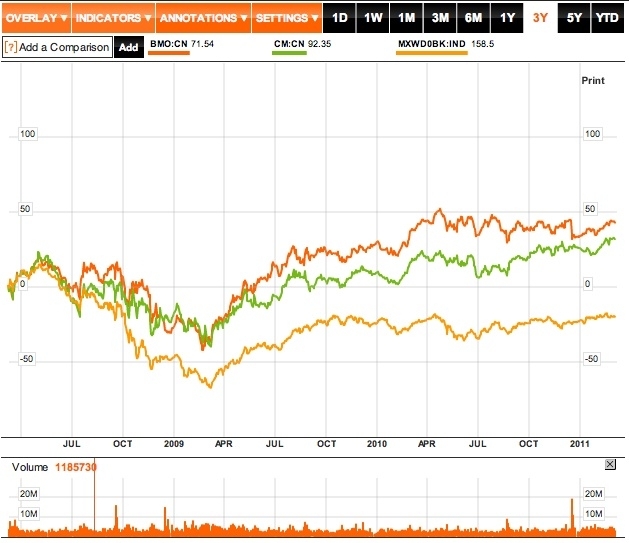
|  |  |  | | | | | SeekingAlpha.com: Home Page | | | | | | | | | | | | | | | | | | | Alicia Damley submits: Given the performance of Canadian banks to date and the underlying fundamentals, there are better opportunities in the U.S. banking sector than in Canada. Priced currently at mid-teen P/Es, valuation metrics already reflect these fundamentals. Buying these stocks was a clear cut decision beginning in 2008 when constraints of the Canadian regulatory framework and a focus on traditional banking services paid off handsomely. Click to enlarge
Here's why to look elsewhere first. Conservative, staid, even boring, have been common descriptors for Canadian banks. Focused on providing customer-centric, on balance sheet loans and mortgages, the banks were far removed from the exotic CDO and CDS products. The sector is stable and best described as an oligopoly, with the top five banks accounting for 85% of the system's total assets. Each of the top five banks boasts a nationwide branch network, in a country that spans five thousand miles and a population
Complete Story » | | | | | | | | | | | | | | | | | | | | | | | | | Research Recap submits: Standard & Poor's says UK banks may be hard pressed to achieve even their lowered return on equity (ROE) targets this year, in its latest Industry Report Card. Selected excerpts:
The 2010 financial results of the U.K. banks and building societies rated by Standard & Poor's Ratings Services indicate an ongoing gradual recovery from the global financial crisis and recession, which we consider hit several of them particularly hard. Impairment losses remained high by historic standards, but fell sharply from the 2009 peak due to more favorable trends in economic variables and asset prices than we had thought likely at the beginning of 2010. Write-downs of structured credit were lower for similar reasons. Banks strengthened their capital, funding, and liquidity positions further in anticipation of Basel III, and in our view this process is set to continue this year and beyond. In 2011, our base-case expectation is for the domestically
Complete Story » | | | | | | | | | | | | | | | | | | | | | | | | | FINalternatives submits: Four years ago, he wasn't even a billionaire. But today, John Paulson is the richest alternative investments mogul in the world, according to Forbes magazine's latest roster of global billionaires. With a net worth of $16 billion — $4 billion more than a year ago — the Paulson & Co. chief displaced George Soros as the richest hedge fund manager this year. Paulson places 39th overall on a list once again topped by Mexican telecommunications billionaire Carlos Slim Helú, with $74 billion. There are 1,210 billionaires in the world today, 109 more than last year. The group has a combined net worth of $4.5 trillion. No fewer than 65 of those billionaires have ties to the alternative investments industry. And six of them are worth at least 10 figures: In addition to Paulson, the alternatives players with at least $10 billion in assets were Michael Dell, who made his fortune
Complete Story » | | | | | | | | | | | | | | | | | | | | | | | | | Zacks.com submits: Jet fuel prices rose over 53% as oil prices increased to above $100 per barrel, given the ongoing civil unrest in the Middle East. Despite the sharp rise in fuel prices, airline traffic picked up significantly in February, attributable to a strong revival in the economy. The month also saw improved performances on the heels of increased air fares and higher revenues collected from extra fees. Airline traffic is measured in billions of revenue passenger miles (RPM), which means one mile flown by one passenger. The carriers are benefiting from strong travel demand, industry consolidation, substantial improvement in yields and better capacity management, which resulted in enhanced supply-demand conditions. Further, it is estimated that U.S. carriers will be able to combat 65-70% of the increase in energy costs with higher revenues in 2011 and 2012. These have already undergone the sixth round of broad-based price increase this year. Many major
Complete Story » | | | | | | | | | | | | | | | | | | | | | | | | | Andrew Wilkinson submits: Sprint Nextel Corp. (S) – Medium-term bullish positioning is building up in Sprint Nextel Corp. options today with shares in the name trading 3.00% higher on the session at $4.84 as of 12:20pm in New York. Investors expecting shares in the provider of various communications products and services to extend gains through May expiration engaged in plain-vanilla call buying, purchasing the options out-right to position for shares to potentially reach a new 52-week high in the next couple of months. Volume is heaviest at the May $6.0 strike where 20,750 calls have changed hands versus previously existing open interest of 7,482 contracts. It looks like roughly 18,000 of the calls were picked up at a premium of $0.08 each. Call buyers make money if Sprint's shares jump 25.6% over the current price of $4.84 to surpass the effective breakeven price of $6.08 by expiration day in May. Sprint Nextel Corp.
Complete Story » | | | | | | | | | | | | | | | | | | | | | | | | | Trefis submits: Lexmark International (LXK) manufactures and sells laser printers and cartridges, primarily to business customers in North America and Europe. It competes with HP (HPQ), Xerox (XRX), Canon (CAJ), and Kyocera (KYO) in the printer business. The recent rise in popularity of tablets, e-readers and other mobile devices has led to more and more people opting to go paperless and shift their content consumption to the digital stage. As Lexmark's core business is the sale of printers and cartridges, this could spur downside to our $47.40 price estimate for Lexmark's stock. Our price estimate currently stands about 30% ahead of market price. (Chart created by using Trefis' app) Slowdown in Printer Sales Over the years, increasing digital communication (e.g. emails, PDFs, and digital forms) has slowed printer demand. People opt to send forms and letters over email rather than printing and mailing a hard copy. Concurrently, greater availability of wireless broadband
Complete Story » | | | | | | | | | | | | | | | | | | | | | | | | | Mannatech Incorporated (MTEX) Q4 2010 Earnings Conference Call March 10, 2011, 10:00 am ET Executives Mark Nicholls [ph] – Acting Treasurer Robert Sinnott – Co-CEO and Chief Science Officer Stephen Fenstermacher – Co-CEO and CFO Presentation Operator Greetings and welcome to the Mannatech Incorporated fourth quarter 2010 earnings conference call. At this time, all participants are in a listen-only mode. A brief question-and-answer session will follow the formal presentation. (Operator instructions) As a reminder, this conference is being recorded. Now, I would like to introduce our moderator for the call today, Mr. Mark Nicholls [ph], Acting Treasurer. Thank you, Mr. Nicholls, you may begin your conference. Mark Nicholls Thank you. Good morning everyone. This is Mark Nicholls, and welcome to Mannatech's fourth quarter 2010 earnings call. Today, you will hear from Mannatech's Co-CEOs, Dr. Robert Sinnott and Stephen Fenstermacher. Before we begin the call, I will first read the Safe
Complete Story » | | | | | | | | | | | | | | | | | | | | | | | | | Brenda Jubin submits: "Investments: Principles of Portfolio and Equity Analysis," coedited by Michael G. McMillan, Jerald E. Pinto, Wendy L. Pirie, and Gerhard Van de Venter (Wiley, 2011), was written for financial analysts as well as aspiring financial analysts. Part of the CFA Institute's book series, it is a weighty tome of more than 600 pages. In twelve chapters it covers such topics as market organization and structure, security market indices, market efficiency, portfolio management, portfolio risk and return, portfolio planning and construction, equity securities, industry and company analysis, equity valuation, equity market valuation, and technical analysis. There is also a separate paperback workbook with problems and solutions. I debated what to focus on in this post and finally decided to look at two methods for valuing equity markets. The assumption is that, whatever the short-term effects of momentum, "economic fundamentals will ultimately dictate secular equity market price trends." (p. 470) (For those
Complete Story » | | | | | | | | | | | | | | | | | | | | | | | | | Craig Walendziak submits: I consider myself a scholar of Warren Buffett and his writings. I have read tomes of biographies written about the legend and nearly every annual letter from Berkshire Hathaway (BRK.A). Since Buffett has never written specifically about investing metrics, most of what is written below is merely educated assumptions on his investment thesis. One of the most in depth books on Warren Buffett's investment style was written by his former daughter-in-law Mary Buffett. Her book "Buffettology" offers a rare in-depth look into the mind of one of the greatest investors of all time. The majority of the metrics I use come from her writings. Below I run Apple (AAPL) through Buffett's gauntlet to see how it holds up to his lofty standards. People that are familiar with my previous articles will notice that I use very similar screens on all of my investments. Is Apple a Consumer Monopoly or Commodity?
Complete Story » | | | | | | | | | | | | | | | | | | | | | | | | | Joel West submits: Both Xconomy and the U-T covered this week's Qualcomm shareholder meeting. (I'm sorry I couldn't make it, but it's been harder to cover the meetings since I moved to Silicon Valley.)
Former U-T writer Bruce Bigelow focused on the five year anniversary of Paul Jacobs being promoted to CEO, while the U-T focused on the share price.
Alas for shareholders, the latter story is far less interesting. Now at $54, the stock has never tested its record $88 close at the end of 1999, at the end of the telecom bubble. While the stock has recovered wonderfully from its post-NASDAQ low of $13, for the past five years it has gone back and forth in a broad trading range of $30-60. In that regard, it almost exactly mimics my Apple (AAPL) stock in the 1980s, when the correct strategy was to wait for the shares to double to $50, then
Complete Story » | | | | | | | | | | | | | | | | | | | | | | | | | | | | | | | | | | | | | | | | | | | | Zacks.com submits: By Dirk van Dijk Initial Claims for Unemployment Insurance rose by 26,000 last week to 397,000 (last week was revised up by 3,000, so one could see it as a 29,000 increase). This was a bit worse than the expected level of 382,000.
While the reversal after several weeks of sharp declines is not welcome, neither is it the end of the world. The weekly numbers, after an erratic few months, seem to have broken decisively to the downside. First the holidays and then the bad weather seemed to have played havoc with the weekly numbers, but those effects should have passed by now. Let us hope the decline resumes next week.
The good news is that we managed to remain below the 400,000 level. If we can stay below it, it probably signals the start of much more robust job growth. While we have had some big upward spikes
Complete Story » | | | | | | | | | | | | | | | | | | | | | | | | | The LFB submits: Major global currency markets have absorbed a near-term period of U.S. dollar buying, anticipated in last week's client notes that highlighted technical reasons that 76.50 on the dollar index would not easily be broken. Recent client notes have also indicated the fundamental reasons why major exporting economies would not be happy to hold U.S. dollar values at such low levels for an extended period of time. With quantitative easing programs potentially coming to an end in the summer of 2011, and with global commodity markets that are in general traded in U.S. dollars now struggling to break resistance, it may be a time that regional currencies will lose ground to the greenback on the near-term charts. Just as global equity markets are battling the 20- and 50-day simple moving averages as support, the dollar index has the same technical areas as upside resistance. The next few sessions of trade may
Complete Story » | | | | | | | | | | | | | | | | | | | | | | | | | Michael Albert submits: I published an article yesterday titled "Utilities Are Warning the Correction is Here" in which I made the argument that the strong outperformance of Utilities relative to the broader stock market on big down and big up days for the past two weeks was an ominous sign for equity prices. The theory? Utilities are highly sensitive to the term structure of interest rates, and generally outperform when there is an expectation by Utilities investors that yields will fall. Since interest rates are a leading indicator of the stock market and the economy, it stands to reason that Utilities were warning of a period of equity price volatility. The question now becomes which area of the stock market is potentially most vulnerable to a decline. To answer this, we must think about human psychology. Because of something called "get-evenitis," human beings, when faced with a loss, tend to hold on to
Complete Story » | | | | | | | | | | | | | | | | | | | | | | | | Chuck Carnevale submits:Pitney Bowes ( PBI), headquartered in Stamford, Connecticut, and founded 1920 is the world's largest manufacturer of postage meters and mailing equipment. The company operates in more than 100 countries throughout the world and employs some 35,000 people. There was a time, in the not-too-distant past, when Pitney Bowes was an above-average growth story, with a modest but above-average growing dividend yield. However, along came the Internet with its e-mail, fax machines, electronic billing, etc., and the growth dynamic of postage meters was forever changed. Even though the Internet changed the business dynamics of this blue-chip, Pitney Bowes today maintains the coveted status of a Dividend Aristocrat by logging 29 consecutive years of dividend increases through calendar year 2010. Although the following dividend graph from Pitney Bowes' website validates this exceptional record of dividend growth, it also illustrates a major change since calendar year 2000. The statement of a 10% compound
Complete Story » | | | | | | | | | | | | | | | | | | | | | | | | | Mark Sunshine submits: Despite the quick run up in gasoline prices, the U.S. economy isn't about to be eaten by the inflation monster. The inflation rate is important because it has a major influence on Fed policy. If the Fed perceives serious inflation risk, it will tighten monetary policy and slow the economy. If the Fed tightens too soon it will kill off the recovery and increase unemployment. On the other hand, if inflation is too low, or if there is deflation, the economy will underperform for a whole host of reasons including the return of a liquidity trap and financial institution failures. So, inflation has to be like Goldilocks' porridge, not too hot, not too cold but just right. As measured by CPI the economy has had almost no inflation since 2007. However, inflation worriers point to rising commodity prices as evidence that inflation is about to take off faster than the
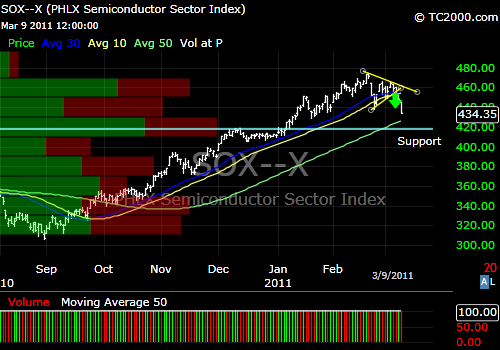
Complete Story » | | | | | | | | | | | | | | | | | | | | | | | | | Jim Farrish submits: Semiconductors broke support and investors should take note of the event. The chart below of the PHLX Semiconductor Index (SOXX) broke lower from the symmetrical triangle. The catalyst came from a downgrade on the sector from analysts. The follow through on the downside was a combination of earnings and analyst meetings. If earnings disappoint in this environment, the punishment is severe. If companies don't say the right things in a investors' meeting, the punishment can be severe. The ripple effect through the technology sector is tops on our watch list. Some stocks are priced for perfection, and anything less has resulted in selling. This push lower has triggered out stops on the sector, but the question remains: Is this an opportunity to buy following the initial selling? [Click all to enlarge] Two ETFs to watch relative to the current ativity in technology are SOXX and iShares S&P GSTI Networking Index
Complete Story » | | | | | | | | | | | | | | | | | | | | | | | | | Dutch Trader submits: Why doesn't China MediaExpress (CCME) go private? A lot of Chinese management teams are fed up with U.S. capital markets. From short sellers and class action suits to negative media reports, you really can get crazy. In the case of China MediaExpress Holdings, the battle between shorts and longs has already been going on too long. Someone has to shout "Enough," so companies can go on with their operations without thinking: "What is next?" The short interest in U.S.-listed companies is just amazing and no regulator takes action. The last news regarding China MediaExpress was a class action law suit about securities fraud. These suits are a real American phenomenon. Research suggests class-action lawsuits should go after the people responsible for your loss, not the company. A paper published by law professors Lynn Bai, James D. Cox and Randall S. Thomas suggests that you may want to rethink your class-action
Complete Story » | | | | | | | | | | | | | | | | | | | | | | | | | Chris Ciovacco submits: Traders, money managers, and individual investors have numerous concerns relative to the market's outlook and risk investments: - QE2 is set to be completed in June.
- Spain's credit rating was downgraded today.
- Unemployment remains high.
- Ongoing unrest in the Middle East.
- Surging oil prices threaten the economic recovery.
- Eye-popping budget and entitlement problems continue in the U.S.
In order to better understand the possible impact of the completion of QE2, we are in the process of studying the "flash crash" period and the period following Ben Bernanke's August 2010 Jackson Hole speech. Our work to date may help us better understand the risks of a continuing correction in today's markets. As outlined on March 6, the longer-term outlook for stocks remains favorable, but the short-term outlook is cloudy. There were very few places to hide during the flash crash correction, which kicked off on April 23, 2010. The pain for investors
Complete Story » | | | | | | | | | | | | | | | | | | | | | | | | | Robert Lewis submits: During the past 10 years the closed end fund industry (as well as the mutual fund and hedge fund industries) has prospered and grown. Historic discounts from net asset values narrowed and numerous, highly specialized funds were launched. Needless to say not all investment strategies worked. Many of the strategies employed by these CEFs offered exceptionally high returns in exchange for taking high risk. The wealth destruction suffered by many of these funds routinely exceeded the general market decline on a percent basis (which itself, was not insubstantial). Not only were investments made in high risk securities but the funds availed themselves of leverage within their capital structure while investing in securities which contained their own internal leverage. This strategy did not produce satisfactory results for many of these funds. In addition to suffering major price declines, the discounts to net asset value also widened with many funds selling at
Complete Story » | | | | | | | | | | | | | | | | | | | | | | | | | Carlos X. Alexandre submits:c As we continue to wait for a resolution to the uprisings in the Middle East and Africa, and try to guess how the domino effect will further affect oil prices, markets continue to price short-term uncertainty and delivering wild fluctuations as news are disseminated — some correct, others simply rumors. If the predictions of $200 oil hold true, whether it's WTI or Brent, it shall be short lived and the impact on prices at the pump can be best calculated by using a common ratio of 2.5 cents per $1 in oil prices. Thus, an increase of $100 from current values, and barring other events such as refinery destruction and disruption, would translate into an additional $2.50/gallon, bringing us to pay about $6 per gallon to keep our automobiles on the move. Definitely not the end of the world, but businesses that depend on consumer discretionary income would be the
Complete Story » | | | | | | | | | | | | | | | | | | | | | | | | | Sydney Williams submits: The latest Health Affairs Policy Brief addresses the question of what happens to employer-based insurance by considering opposing viewpoints. While there's no clear answer, the likelihood of an employer not maintaining coverage does appear to decrease with the size of the organization. If a Fortune 500 employer were to announce elimination of coverage, shares in Unitedhealth (UNH), Aetna (AET), Wellpoint (WLP), and other companies offering third-party administration services (claims processing, premium collection, benefit design and enrollment) to self-funded employers could decline on the perception that other large employers might act likewise. About 160 million people obtain their health coverage through the workplace, primarily through larger employers. 69 percent of all U.S. employers offer health insurance to their employees, including 99 percent of companies with 200 or more employees. Beginning in 2014, the Affordable Care Act requires employers with more than 50 full-time employees to offer qualified health insurance coverage, or
Complete Story » | | | | | | | | | | | | | | | | | | | | | | | | | Joel West submits: Brett Arends wrote a glowing review Wednesday in the WSJ of his nookColor and why it's a better bargain than the iPad 1 or iPad 2. The main difference between his experience and mine is that he hacked his to be a fully functioning Android tablet: I downloaded a very simple, perfectly legal software fix from the Internet that turned it into a fully functioning tablet running on Google's Android platform. The fix, known as a "rooting," unlocks Barnes & Noble's proprietary overlay. The instructions came via Ars Technica, a reputable site devoted to technology, and were pretty easy to follow.
I wasn't really expecting it to work. I tried it as an experiment. But the results were remarkable.
The Nook Color, which was designed mainly for reading books and magazines, is about half the size of an iPad or a Xoom. It weighs about 30% less. It runs on
Complete Story » | | | | | | | | | | | | | | | | | | | | | | | | | The LFB submits: Global commodity markets are trading in very disjointed fashion, with huge divergence within the soft commodity markets, some precious metals easily holding higher while others are testing support, and resource commodities now starting to look overweight on speculative interest. Unlike the regular use of commodity markets, that historically hedge forward commitments on global growth or contraction, the increase in speculative use of commodity markets to hedge dollar manipulation and regional civil unrest will now start to create volatility on an intraday basis. Tests of upside resistance are now weak and are not holding as easily as they have done previously. Gold bullion futures trade continues its 12-session sideways crawl, that has main support at 1400 and major resistance at 1450. Trend, momentum, sentiment, and price action reads are all confirming that fair value has been found on gold, with one or two 30-minute periods of trade each day containing most
Complete Story » | | | | | | | | | | | | | | | | | | | | | | | | Pharmalot submits: Every so often, a new approval generates significant attention. And the FDA endorsement of Benlysta, the first new treatment for lupus in 56 years, is one of those moments. The injectable med, which will be marketed by Human Genome Sciences (HGSI) and GlaxoSmithKline (GSK), is forecast to generate at least $2 billion in annual sales thanks to a $35,000 price tag, despite cautionary language for certain patients. The med, which will actually cost about $40,000 in the first year, will become available later this month. There is no REMS requirement or Black Box warning, which heartened Wall Street. Nonetheless, insurance reimbursement remains somewhat fuzzy. Meanwhile, Human Genome Sciences agreed to conduct another clinical trial in African-American lupus patients. Here's why… "As expected, the label states that black/African Americans benefitted less," writes Leerink Swann biotech analyst Joseph Schwartz in an investor note. He points out that the label states 'although no
Complete Story » | | | | | | | | | | | | | | | | | | | | | | | | | Osman Gulseven submits: During the last two years, the Dow Jones Industrial Average increased by 72%. The striking performance of stock prices triggers concern about whether the stock market is overvalued or not. From a bullish perspective, the fundamentals are strong: The increase in stock prices can be attributed to the fast recovery from depression and increasing corporate profits. If we look at the current valuations from a bearish side, a sharp correction is inevitable to normalize stock prices: Close-to-zero interest rates make it easier to borrow and invest using borrowed money. As long as there is someone else who is willing to pay more for the stocks, prices will rise. That is why stocks have high returns. I decided to look at the common stock valuations from Benjamin Graham's perspective. Known as the father of value investment, Benjamin Graham was an economist and a professional investor. Warren Buffett points to him as
Complete Story » | | | | | | | | | | | | | | | | | | | | | | | | | The 451 Group: Inorganic Growth submits: By Brenon Daly Just since last summer, the data-warehousing industry has seen a wave of consolidation sweep most of the sizable startups into the portfolios of larger vendors. While dramatically reshaping the industry, the concentrated dealmaking has also generated outsized returns for venture firms that have put money into some of the startups that are tackling the problems of 'big data.' By our calculation, the four recent data-warehousing exits – on average – have been 10-baggers for their backers. The eight-month M&A spree started last July, when EMC reached for Greenplum. Two months later it was IBM's turn to take out Netezza, the sole data-warehousing startup that had actually made it to the public market in recent years. In mid-February, Hewlett-Packard (HPQ) reversed its long-held strategy to stay with internal data-warehousing development and gobbled up Vertica Systems. And then just last week, the granddaddy of the industry, Teradata (TDC), snagged
Complete Story » | | | | | | | | | | | | | | | | | | | | | | | | | | | | | | | | | | | | | | | | | | | | Trefis submits: BP (BP) received a significant setback early this year when an oil leak discovered in the Trans Alaska Pipeline forced the company to reduce oil production from its operations in Alaska by 95%. [1] The pipeline was operated by Alyeska Pipeline Service Co., a joint venture between BP and its competitors ExxonMobil (XOM) and ConocoPhillips (COP). Our price estimate for BP stands at $54.32, implying a 15% premium to market price. Oil and gas production operations by the various companies in Alaska's North Slope region contribute about 630,000 barrels of oil daily, which is approximately 9% of the total oil production in the United States. [2] And almost two-thirds of this production – more than 400,000 barrels of oil – is because of BP. Chart created using Trefis' app See our full analysis and $54.32 price estimate for BP BP's History with Alaska BP has been operating onshore oil wells
Complete Story » | | | | | | | | | | | | | | | | | | | | | | | |  Larry Dignan (ZDNet) submits: Larry Dignan (ZDNet) submits: IDC said that 10.1 million media tablets were shipped in the fourth quarter and to no one's surprise Apple (AAPL) and its iPad dominated. However, Samsung's Galaxy Tab walked away with 17 percent market share. What remains to be seen is how the availability of the iPad 2 on Friday changes the equation in the first and second quarters. Also: Apple's iPad 2 launch: Here comes the obsession over long lines IDC also delivered its e-reader scorecard and Amazon's Kindle dominated. More than 6 million e-readers shipped in the fourth quarter. According to IDC's statement: - Apple's tablet share fell from 93 percent in the third quarter to 73 percent in the fourth.
- Samsung's Galaxy Tab had 17 percent share in the fourth quarter, but isn't expected to keep it for long. Samsung is prepping a larger Galaxy Tab based on Android 3.0 Honeycomb.
- Almost 18 million tablets shipped in 2010.
Complete Story » | | | | | | | | | | | | | | | | | | | | | | | | | Zacks.com submits: Simcere Pharmaceutical Group's (SCR) fourth quarter 2010 earnings of 16 cents per American Depository Share (ADS) easily surpassed the Zacks Consensus Estimate of 10 cents. The company suffered a loss of 27 cents per ADS in the final quarter of 2009 (on an adjusted basis). Higher revenues benefited earnings in the reported quarter. Quarterly Details Revenues at Simcere Pharma came in at $89.1 million in the final quarter of 2010. Revenues edged past the Zacks Consensus Estimate of $89 million. In terms of the local currency revenues climbed 7.6% to RMB587.7 million. Higher sales of cancer drugs, Endu (up 99.7% in local currency), Sinofuan (up 18% in local currency) and edaravone injection products (up 5.1% in local currency) helped boost revenues. Gross margin went up to 84.1% during the quarter, compared with 83.6% in the prior-year quarter. Stable pricing of the company's products helped boost the margin. Simcere Pharma's research
Complete Story » | | | | | | | | | | | | | | | | | | | | | | | | | Kurtis Hemmerling submits: Before we outline the value stocks with hidden growth that are mostly ignored by the investment community, I need to explain how we get there. It starts with a famous duo that rocked the investment community with a paper showing how value stocks outperformed growth. Going Beyond Fama and French Portfolios
Fama and French (Value versus Growth: The International Evidence, 1997) have created quite a following with their 3 model approach to building portfolios that outperform the market by an average of 7.6% annually. They build massive portfolios of high book to price stocks and then compare these to the results of stocks with low book to price stocks (HML – high minus low). Another portfolio compares small market cap stocks with large market cap stocks (SML – small minus large). However, there seems to be a lack of individual data relating to individual stocks. What fundamental factors influence small
Complete Story » | | | | | | | | | | | | | | | | | | | | | | | | | | | | | | | | | | | | | | | | | | | | Karl Denninger submits: Let's start with the trade balance: The U.S. Census Bureau and the U.S. Bureau of Economic Analysis, through the Department of Commerce, announced today that total January exports of $167.7 billion and imports of $214.1 billion resulted in a goods and services deficit of $46.3 billion, up from $40.3 billion in December, revised. January exports were $4.4 billion more than December exports of $163.3 billion. January imports were $10.5 billion more than December imports of $203.6 billion.
Yuck. China reported a trade deficit overnight as well. Someone has to hold the surplus. Anyone care to guess who it is? (that's a trick question, incidentally.) Jobless claims came very close to losing their "3" handle and regaining the "4": In the week ending March 5, the advance figure for seasonally adjusted initial claims was 397,000, an increase of 26,000 from the previous week's revised figure of 371,000. The four-week moving average
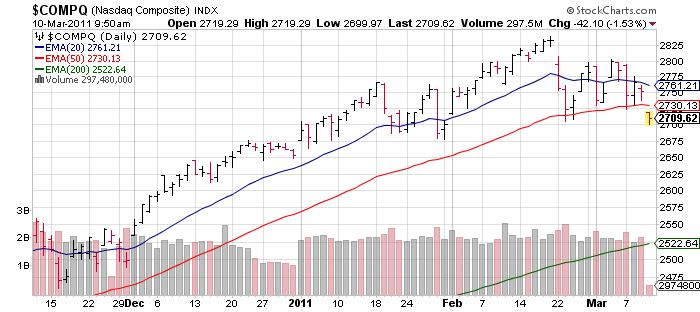
Complete Story » | | | | | | | | | | | | | | | | | | | | | | | |  Hickey and Walters (Bespoke) submit: Hickey and Walters (Bespoke) submit: The tech-heavy Nasdaq 100 has been hit especially hard during the most recent market pullback. As shown in the first chart below, the index now
Complete Story » | | | | | | | | | | | | | | | | | | | | | | | | | H.J. Huney submits: Recently, I've been reading Edward Glaeser's "Triumph of the City." It's an excellent read and looks how cities have thrived, failed, and have created greater economic and intellectual prosperity that would have been unachievable otherwise. While reading Glaesar's work, I could not help but to notice parallels with modern China. China's central planners might be in agreement with Glaeser's basic thesis, on one level. After all, has any nation in the history of the world promoted more rapid upward urbanization than the People's Republic of China? China's urban population percentage more than doubled from 1980 to 2010; an astonishing figure. While "Triumph" points out the great efficiencies of urban economies, it also sets out to expose some of the great failures of cities, with Detroit being the classic American example. While it's simple to look at what China's built and be amazed, it's also simple to ignore some of the
Complete Story » | | | | | | | | | | | | | | | | | | | | | | | | | Trader Mark submits: Let's try this again - we just had this conversation Monday. The NASDAQ (QQQQ) - yet again - has broken the 50 day moving average, although today's move is more impressive than the last occurrences as it was a gap down situation. Hence, no part of today's range in the index has been above the 50 day moving average. When this break of support happened early afternoon Monday, the NASDAQ turned on a dime and rallied 1% in just over 2 hours. (Click charts to expand) As I state constantly, what matters is the CLOSING price, not the intraday price, BUT today's action is not looking prone to a
Complete Story » | | | | | | | | | | | | | | | | | | | | | | | | | Mark J. Perry submits: Slate.com has an article titled "Why hasn't the Internet helped the American economy grow as much as economists thought it would?" about Tyler Cowen's e-book "The Great Stagnation." Here's a really interesting point: Maybe it is not the growth that is deficient. Maybe it is the yardstick that is deficient. MIT professor Erik Brynjolfsson explains the idea using the example of the music industry. "Because you and I stopped buying CDs, the music industry has shrunk, according to revenues and GDP. But we're not listening to less music. There's more music consumed than before." The improved choice and variety and availability of music must be worth something to us—even if it is not easy to put into numbers. "On paper, the way GDP is calculated, the music industry is disappearing, but in reality it's not disappearing. It is disappearing in revenue. It is not disappearing in terms of what you
Complete Story » | | | | | | | | | | | | | | | | | | | | | | | | | NakedValue submits: Bruce Berkowitz's Fairhome Fund has gotten a lot of media coverage for positions in beaten down names like General Growth Properties (GGP), St Joe Company (JOE), Citigroup (C) and Bank of America (BAC). But it was probably Berkowitz's most enigmatic position in American International Group (AIG) (see: Undervalued AIG warrants) that gave birth to an under the radar position with big potential. Asian insurance company, AIA Group (AAIGF.PK, 1299.HK) could be Fairholme Funds' next top performing stock pick. Berkowitz' stake in AIA Group doesn't get much attention. The stock is not listed on the SEC Form 13F because it is listed in Hong Kong. According to the Fairholme's 2010 Annual Report (.pdf), as of November 30, 2010, the fund had a stake of 302.2 million shares of AIA Group currently worth $922 million. Originally founded in 1931, AIA Group is a pan-Asian life insurance company with operations in 15 markets,
Complete Story » | | | | | | | | | | | | | | | | | | | | | | | | | Wall Street Strategies submits: By Carlos Guillen So far we continue seeing a strong year for the semiconductor industry; this is despite the fact that last year semiconductor industry revenue grew by a phenomenal 32 percent. Clearly, revenue growth this year will be much smaller than that achieved last year, but we are encouraged that forecasts in general are being held firm and in some cases are actually improving. We are also encouraged by the most recent data from the semiconductor industry association that showed continuing sequential growth during January, a period that usually tends to be a down for the industry. According to SIA data, the three month moving average global semiconductor revenue in January increased approximately 1.5 percent to $25.5 billion, representing a year-over-year increase of 14.0 percent. This is certainly encouraging since January is not typically an up month for semiconductor revenues. In fact, the March quarter as a whole is
Complete Story » | | | | | | | | | | | | | | | | | | | | | | | | | Investment U submits: By Tony D'Altorio China is the world's biggest and fastest growing consumer market. So it makes sense that Best Buy (BBY) – the world's largest electronics retailer, by sales – would do great there. Yet the company fell flat on its face instead. A few weeks ago, it had to announce the closure of all nine of its branded stores in China. It will continue running the 170 Five Star brand stores it acquired in 2006. And come the 2012 fiscal year, Best Buy hopes to opening another 40-50 more of them. But its traditional brand captured less than 1% of the China market. It got trounced soundly by homegrown rivals Gome Electrical Appliances (GMELY.PK) and Suning Appliance Company, each with over 1,000 national locations. The American business can at least take comfort that it's not alone. Home Depot (HD) closed its last outlet in Beijing a month before, and
Complete Story » | | | | | | | | | | | | | | | | | | | | | | | | | Dennis U. Atuanya submits: There is the possibility of a global crude oil price shock arising from the current unrest in the MENA (Middle East, North Africa) region — and the impact on a sluggishly rebounding global economy could be devastating. The precise outcome of events may be currently unclear but crude oil price projections have been wide-ranging. For example, while some analysts expect a gradual retreat of crude oil prices for 2011 to an average of US$95 per barrel after the recent peaks, others see a peak of US$300 and an average price of US$200 per barrel for the year. World Oil reports that a company recently slashed odds on a US$200 per barrel crude oil to just 3/1. Global markets in their aversion to uncertainties have been restive even in spite of ameliorative efforts ... and perhaps rightfully so: Spare Production Capacity Marginal crude oil supply, crucial to moderation of global crude
Complete Story » | | | | | | | | | | | | | | | | | | | | | | | | | | | | | | | | | | | | | | | | | | | | Mariusz Skonieczny submits: IDT Corporation (IDT) is a company that has caused investors lots of pain and joy depending on when they purchased their shares. From the following price chart, you can see that it was trading as high as $41.84 per share on September 18, 2006, and as low as $0.71 per share on December 19, 2008. Now, it is back at around $25 per share. Anyone who bought it at the beginning of 2009 made a nice return. By simply looking at the chart, it is easy to assume that since the stock has already had such a huge run, the money has already been made. However, I do not believe this is the case. It does not matter where the stock has been, but where it is going -- and what we get for the price that we pay. [Click all to enlarge] Business Description IDT Corporation is a consumer
Complete Story » | | | | | | | | | | | | | | | | | | | | | | | | | Doug Short submits: The Department of Labor's Unemployment Insurance Weekly Claims Report was released this morning for last week. In the week ending March 5, the advance figure for seasonally adjusted initial claims was 397,000, an increase of 26,000 from the previous week's revised figure of 371,000. The four-week moving average was 392,250, an increase of 3,000 from the previous week's revised average of 389,250. The advance seasonally adjusted insured unemployment rate was 3.0% for the week ending Feb. 26, unchanged from the prior week's unrevised rate of 3.0%. The advance number for seasonally adjusted insured unemployment during the week ending Feb.26 was 3,771,000, a decrease of 20,000 from the preceding week's revised level of 3,791,000. The four-week moving average was 3,833,250, a decrease of 34,750 from the preceding week's revised average of 3,868,000. Today's number was well below the Briefing.com consensus expectation of 400,000 claims. As we can see, there's a good
Complete Story » | | | | | | | | | | | | | | | | | | | | | | | | | Russ Koesterich submits: One of the many ironies of markets last year was the extent to which inflation occupied investors' attention, despite its near universal absence. While inflation has recently accelerated in emerging markets and a few developed ones – the UK and Singapore, for example – by and large, inflation was and is still largely absent in the developed world. In mid-2010, inflation in OECD countries hit a record low of 1.60%, while U.S. core inflation, which excludes food and energy prices, bottomed at 0.60%, the lowest reading since records began back in 1957. Yet, record low inflation did not stop investors from worrying about it. Last year gold and silver gained 30% and 83% respectively. So far in 2011 gold has taken a bit of a respite and is relatively flat. However, silver's run continues with the metal up more than 20% so far year-to-date. While investor demand has certainly been
Complete Story » | | | | | | | | | | | | | | | | | | | | | | | | | Andrew Wilkinson submits: PIMCO's Bill Gross turned bearish on U.S. government debt and eliminated treasuries from the world's largest bond fund ahead of creeping doubts in the health of the recovery. No doubt such bond-dumping by the much-admired PIMCO founder took place before the recent acceleration in crude oil prices, yet the sense of elevated geopolitical risks appears to be a challenge to his view that the Fed is on the verge of exiting its over-easy policy stance. Yields slipped once more on Thursday after signs of slowdown in China spooked global stocks, while selling in the S&P picked up as a recovery in the labor market took a pause. Eurodollar futures – The Gross confession follows a run-up in bond yields during February to 3.77% as investors waxed lyrical about the health of the economy. The benchmark yield today fell to the lowest in a week to 3.42% after weekly initial claims
Complete Story » | | | | | | | | | | | | | | | | | | | | | | | | | James Picerno submits: This morning's latest on weekly jobless claims is a bit of a setback, but it's too early to panic. For one thing, last week's seasonally adjusted 26,000 jump in new filings for jobless benefits is small for this series, given how much it bounces around from week to week. That argument won't wash with the thousands of newly unemployed, of course, but as a macro matter there's nothing particularly worrisome in today's report. That is, until you start looking beyond the data. But before we consider the wider world, it's worth noting that even after last week's rise, jobless claims remained under the seasonally adjusted 400,000 mark for the third straight week—a new record for this cycle. Should we anticipate four in a row?
(Click chart to enlarge) In another bid to see the glass as half full, consider that the biggest changes in last week's declines for new claims
Complete Story » | | | | | | | | | | | | | | | | | | | | | | | | | Michael Becker submits: Traditional wisdom holds that biotechnology companies benefit from collaborations with their larger pharmaceutical peers, which can help validate a company's technology, provide capital to help fund clinical development, and enable access to experienced clinical, regulatory and commercial infrastructure. While this was certainly true in the early days of biotechnology, the industry has now matured – ushering in a new era whereby executives must carefully weigh the trade-offs between raising capital to go alone [equity dilution] and sharing economics with a partner [asset dilution]. For a comparison between the old and new paradigms in biotechnology collaborations, refer to Table 1. Table 1. Old Versus New Paradigm in Biotechnology Collaborations | Old Paradigm | New Paradigm | | Biotechnology company requires validation by large pharmaceutical partner to attract investment. | Investors are sufficiently experienced to assess the prospects for clinical, regulatory, and commercial success on their own. | | Complicated drug development paths are best navigated by large pharmaceutical |
Complete Story » | | | | | | | | | |  | |  | |  |




No comments:
Post a Comment