|  |  |  | | | | | SeekingAlpha.com: Home Page | | | | | | | | | | | | | | | | | | | Peregrine Pharmaceuticals (PPHM) Q3 2011 Earnings Call March 11, 2011 4:30 pm ET Executives Joseph Shan - Vice President of Clinical & Regulatory Affairs Steven King - Chief Executive Officer, President, Director, Chief Executive Officer of Avid Bioservices Inc and President of Avid Bioservices Inc Paul Lytle - Chief Financial Officer, Principal Accounting Officer, Corporate Secretary, Chief Financial Officer of Avid Bioservices and Corporate Secretary of Avid Bioservices Philip Thorpe - Member of Scientific Resource Board of Core Technologies Amy Figueroa - IR, BioCom Partners Analysts Joseph Pantginis - Roth Capital Partners, LLC George Zavoico - McNicoll, Lewis & Vlak LLC Presentation Operator Good day, ladies and gentlemen, and welcome to the Peregrine Pharmaceuticals Third Quarter Fiscal Year 2011 Financial Results Conference Call. [Operator Instructions] I would now like to turn the call over to your host, Ms. Amy Figueroa with Peregrine Pharmaceuticals. Please go ahead. Amy Figueroa Thanks, Melina.
Complete Story » | | | | | | | | | | | | | | | | | | | | | | | | | Greentech Media submits: By Michael Kanellos Microsoft (MSFT) will spend less time at Hohm and more at work. The software behemoth is currently working with partners to figure out a strategy for software and services for managing energy consumption in commercial buildings, according to Rob Bernard, the company's chief environmental strategist. "Upwards of 20% of energy can be reduced by not replacing windows but by deploying technology," he said at a gathering at the Commonwealth Club in San Francisco. Additionally, Microsoft is looking at ways to tie building management systems into predictive analysis tools to better balance energy production and consumption. With predictive analysis tools, air conditioners in buildings could be turned down, for example, to compensate for a sudden decline in power production at a wind farm. 'What are the right ways to structure this ecosystem? Today it is all disconnected sources of information," he said. If this strategy sounds familiar, it
Complete Story » | | | | | | | | | | | | | | | | | | | | | | | | | ETF Database submits: Despite a devastating earthquake in Japan and a planned "day of rage" in Saudi Arabia, U.S. equity markets managed to close out the week on a high note pretty much across the board. The Dow rose by 60 points on the day while the broader indexes finished higher as well with the Nasdaq rising by 0.5% and the S&P 500 gaining 0.7%. Meanwhile, commodities were more mixed as gold gained roughly $6/oz. and oil tumbled by more than $2 a barrel as traders sold off the fuel in anticipation of a collapse in demand out of Japan and a complete non-event out of Saudi Arabia's protests. While many investors had expected today's focus to be on Saudi Arabia, one of the worst earthquakes in history changed that as the 8.9 magnitude quake shook the northeast coast of Japan. The quake also set off 30-foot-high waves which spread across the Pacific
Complete Story » | | | | | | | | | | | | | | | | | | | | | | | | | The Deliberate Trader submits: The markets may be telling us that it is time to get defensive, or they may be telling us to stay the course and remain on offense. In recent days, depending upon what you read or how you analyze it, you can come to different conclusions according to your mood. However, one of the ways that we can try to take advantage of a mature market run while protecting ourselves from potentially staggering, abrupt declines is through the identification of resilient companies making products that consumers always need. These are also known as defensive stocks. Since March 2009 the drug sector has been a mere average performer, and one of the weaker market sectors on a relative strength basis. The sector may be ready to rotate into a leadership role during the next upward phase of the bull market ... if it takes place. If it doesn't, we think we've
Complete Story » | | | | | | | | | | | | | | | | | | | | | | | | Kim Arthur submits: Several times a week, Seeking Alpha's Jason Aycock asks money managers about their single highest-conviction position - what they would own (or short) if they could choose just one stock or ETF.
Kim Arthur is founding partner, CEO and portfolio manager at Main Management, a San Francisco-based RIA working with high-net-worth individuals and institutional investors. He began his career at Montgomery Securities in 1987. Which single asset class are you most bullish/bearish about in the coming year? What ETF position would you choose to best capture that? We are constructive on the U.S. telecom sector for this year. Telecom is one of the minor global industry classification standards (GICS) with a 3% weighting of the S&P 500. The sector includes household names like AT&T (T), and Verizon (VZ, VOD), and smaller names like Shenandoah Telecommunications (SHEN) and Cbeyond (CBEY). The sector includes fixed-line communications and wireless communications, and is a
Complete Story » | | | | | | | | | | | | | | | | | | | | | | | | | Marc Chaikin submits: Turmoil in the Middle East has driven oil prices higher. Leading economists believe this has resulted in a slowdown in global economic growth and that the impact will spread in the next few months. Mark Zandi, chief economist at Moody's Analytics, cut his forecast for U.S. economic growth for 2011 to 3.5% from 3.9%, citing rising oil prices and spending cuts in Washington. Most importantly he raised his estimate of the average price of oil for 2011 to $100 per barrel from $90. U.S. consumers have felt this pain daily in recent weeks as they stop to refuel their vehicles and have dipped deeper into their pockets just to get around. We believe buying oil company shares on the current price pullbacks is a strategy which will succeed based on the rising price of oil and a continued uptrend in the U.S. stock market led by large cap stocks. We
Complete Story » | | | | | | | | | | | | | | | | | | | | | | | | New Finance submits: Microsoft ( MSFT) has ruled the past couple of decades due to its own encompassing advantage over rivals: the Windows operating system. Windows has been a cash cow with no rival in the world of software, and allowed Microsoft to survive even when it made poor choices; it was and is the company's ultimate weapon. Even if someone had made a large scale OS worth anything, Windows was so entrenched and MSFT so deft at squeezing competitors (remember Netscape?) that they would have probably been left to the geeks such as the likes of Linux. So what is the next company that may have the opportunity to seize such an advantage
Complete Story » | | | | | | | | | | | | | | | | | | | | | | | | | KMG Chemicals (KMGB) Q2 2011 Earnings Call March 11, 2011 10:00 am ET Executives John Sobchak - Chief Financial Officer and Vice President J. Butler - Chief Executive Officer, President, Director and Member of Risk Oversight Committee Analysts Stephen DeNichilo - ACK Asset Daniel Rizzo - Sidoti & Company, LLC Arnold Ursaner - CJS Securities, Inc. Eric Glover - Canaccord Adams Presentation Operator Good morning, and welcome to the KMG Chemicals, Inc. Second Quarter 2011 Conference Call. We would like to begin by reminding you that the information in this conference call includes certain forward-looking statements that are based upon assumptions that in the future may prove not to have been accurate and are subject to significant risks and uncertainties, including statements as to the future performance of the company. Although the company believes that the expectations reflected in its forward-looking statements are reasonable, it can give no assurance that
Complete Story » | | | | | | | | | | | | | | | | | | | | | | | | | FiberTower (FTWR) Q4 2010 Earnings Call March 11, 2011 11:30 am ET Executives Kurt Van Wagenen - Chief Executive Officer, President and Director Carolyn Capaccio - Vice President Thomas Scott - Chief Financial Officer, Principal Accounting Officer, Senior Vice President and Secretary Analysts Gary Morman Richard Prentiss - Raymond James & Associates, Inc. Gerard Hallaren - JRPG Presentation Operator Good morning, ladies and gentlemen, thank you for standing by. Welcome to the FiberTower's Fourth Quarter and Year-end 2010 Earnings Conference Call. [Operator Instructions] This conference is being recorded today, Friday, March 11, 2011. I would now like to turn the conference over to Carolyn Capaccio of Lippert/Heilshorn Associates. Please go ahead, Ma'am. Carolyn Capaccio Thank you, Brandy. Good morning, everyone. Thank you for joining us for FiberTower Corporation's 2010 Fourth Quarter Conference Call. Joining me today on the call are Kurt Van Wagenen, FiberTower's President and Chief Executive Officer; and
Complete Story » | | | | | | | | | | | | | | | | | | | | | | | | | Michael James McDonald submits: 9% Unemployment Equals 100% Stock Gains Thursday's sell-off on trade deficit or employment news doesn't make any investment sense. We've had high unemployment for two years and the markets rallied 100%. Why worry now? In fact a large percent of the record corporate earnings is based on cheap foreign labor and therefore high U.S. unemployment. Reducing American jobs and making things overseas allow corporations to make things cheaper and generate more earnings worldwide. It also helps keep interest rates low here, which allows for higher valuations of those earnings, which is the best of both worlds. A Zero Trade Deficit Roughly Equals 4% Unemployment As we mentioned in the article " 9% is Now Full Employment in America," the large trade deficit and high unemployment are directly linked. The $500 billion we import over exports is where the jobs are. Over the last 20 years the U.S. lost about 20 million
Complete Story » | | | | | | | | | | | | | | | | | | | | | | | | | Michael Fitzsimmons submits: The Eagle Ford Shale play is located primarily in 24 counties of southern Texas. It is one of the most active regions for oil and gas E&P in the United States. The Eagle Ford contains a high percentage of carbonate shale - upwards to 70% in south Texas. The higher percentage of carbonate makes the Eagle Ford shale more brittle and "fracable." This means the Eagle Ford is more capable of producing a higher percentage of oil (rather than natural gas) compared to the other traditional shale plays. According to data from the Texas Railroad Commission, the following chart summarizes Eagle Ford one-year (2009-2010) oil and gas E&P growth: Eagle Ford Shale Oil and Gas Production Growth | | Units | 2009 | 2010 | % Growth | OIL | barrels | 307,366 | 2,596,263 | 745 % | GAS | Bcf | 16 | 64 | 300 % | Drilling Permits Issued | 94 | 1229 | 1207 % | There were 72 producing oil leases
Complete Story » | | | | | | | | | | | | | | | | | | | | | | | | | Trefis submits: Netflix (NASDAQ:NFLX) is an online movie rental company that operates with a two delivery methods: DVD shipments and online streaming. The shift to online streaming is growing in popularity and is evident as DVD shipped per subscriber is declining. More than one third of new subscribers are now going for streaming-only service, and Netflix is aggressively beefing up available content to attract new users. Netflix's growth will come from increasing its subscription base, and we believe that Netflix will look to international markets as a core element to its growth plans (beyond Canada). Although Netflix's business model is unique, it still competes with Apple's (NASDAQ:AAPL) iTunes, Hulu, VoD services from pay-TV providers like Comcast (NASDAQ:CMCSA), Time Warner Cable (NYSE:TWC) and others. Our price estimate for Netflix stands at $119, which is well below the current market price of around $200. The discrepancy primarily results from our belief that Netflix may
Complete Story » | | | | | | | | | | | | | | | | | | | | | | | | | Insider Monkey submits: Oil prices are hovering around $100, and you may be thinking about investing in energy companies. We follow hedge fund managers because they're the smartest investors around. They leave less to chance than most investors. They go great lengths to get an "edge" over ordinary investors. We follow corporate insiders because they have access to material, non-public information and they sometimes trade based on it. We also follow hedge fund managers because they have the resources to do extensive research on public companies and they have access to experts who can guide them. We believe we are more likely to beat the market by imitating insiders and hedge funds than trading against them. Based on the transactions of nearly 700 hedge funds, we compiled this list of top eight energy companies hedge funds were buying like crazy during the fourth quarter: 1. Exxon Mobil Corp. (XOM) : More than 100 hedge
Complete Story » | | | | | | | | | | | | | | | | | | | | | | | | | Money Morning submits: By David Zeiler If state legislatures across the country get their way, Amazon.com Inc.'s (AMZN) 16-year holiday from collecting sales tax will come to an end - with unpleasant consequences for the online retailer. The U.S. Supreme Court in 1992 established that only retailers with a physical presence (called "nexus") in a given state are required to collect a sales tax from their patrons. But with state budgets being squeezed, more and more legislatures are trying to rope in online retailers - especially Amazon, a company that was specifically engineered to profit from the Supreme Court's ruling. "[Amazon CEO] Jeff Bezos has built a company strategically around avoiding sales tax. But they're going to have to deal with this," retail analyst David Strasser, a managing director at Janney Montgomery Scott, told Forbes. In states that have sales tax (five have none), adding it to the transaction will increase the cost
Complete Story » | | | | | | | | | | | | | | | | | | | | | | | | | Chris Ciovacco submits: On March 11, the markets got some more bad news in the form of higher than expected inflation in China and fewer job openings in the United States, which will not help with the recent trend to avoid risk. According to Bloomberg: Today's reports signaled the central bank's monetary tightening has been insufficient so far to contain prices, in an echo of pressures across Asia that spurred South Korea, Thailand and Vietnam to raise interest rates this week. People's Bank of China Governor Zhou Xiaochuan said today interest rates will be used to curb inflation, and played down the role of currency gains, which U.S. officials have encouraged China to use.
On the employment front in the U.S., the Labor Department said in a statement released Friday job openings in the U.S. decreased in January to the lowest level in four months. Job openings declined by 5.5%, caused in part
Complete Story » | | | | | | | | | | | | | | | | | | | | | | | | | Zacks.com submits: Roche Holding Ltd. (RHHBY.PK) recently reported positive data from a late-stage study (RISE) of its eye drug Lucentis. The study is evaluating the safety and efficacy of the drug for treating patients suffering from diabetic macular edema (DME). DME leads to swelling of the retina, in patients with type I or type II diabetes. The disease can cause blurred vision, severe vision loss and at times blindness. Data from the 36 month trial demonstrated that after 24 months of treatment with Lucentis, 44.8% of the patients who were on 0.3 mg of the drug and 39.2% of the patients who were on 0.5 mg of the drug were able to read at least 15 more letters on the eye chart, as compared with 18.1% of patients who were given placebo. Roche added that an improvement in vision was seen within seven days of starting treatment with Lucentis. RISE is the
Complete Story » | | | | | | | | | | | | | | | | | | | | | | | | | Sy Harding submits: Slowing economic growth is usually a positive for bonds. Bonds are bought as a safe haven when global stock markets are in corrections. My technical indicators have reversed from a timely sell signal on bonds last November to a buy signal. Bill Gross, founder and manager of PIMCO's giant Total Return fund, said this week that he is negative on U.S. debt and has dumped all U.S. treasury bonds from his fund. And even that may be a buy signal. On slowing global economic growth, reports this week from China, the world's 2nd largest economy, and Japan, the world's 3rd largest economy, were discouraging. Japan's economic growth for the 4th quarter of last year was revised downward to a negative 1.3%. It will not be improved by the devastating earthquake and Tsunami. China's economy has been sitting on a real-estate bubble for some time, with 64 million empty housing units
Complete Story » | | | | | | | | | | | | | | | | | | | | | | | | | Matthew Bradbard submits: I'm taking off early today as I'm feeling under the weather, so I will post pre-close on some markets but give an overview of where I stand. May Crude came down and tested the 38.2% Fibonacci retracement level overnight. We anticipate more downside in the coming weeks … perhaps an additional $3-5. The 20-day MA capped rallies all week in natural gas, just below $4 in the May contract. We still favor May bullish exposure as our target remains $4.25. As of this post the indices are back above the 50-day MA trading marginally higher. Not selling off after the events overnight in Japan is a tell that we may bounce from here. That being said, we've advised clients to lighten up on their shorts. The dollar failed to get through the 20-day MA today, giving back virtually all of yesterday's gains. Aggressive traders should still position themselves expecting a
Complete Story » | | | | | | | | | | | | | | | | | | | | | | | | | Brooks McFeely submits: 4:08 PM, Mar 11, 2011 - - NYSE up 55.56 (+0.7%) to 8,255.63
- DJIA up 59.79 (+0.5%) to 12,044
- S&P 500 up 9.17 (+0.7%) to 1,304
- Nasdaq up 14.59 (+0.5%) to 2,716
GLOBAL SENTIMENT - Hang Seng down 1.55%
- Nikkei down 1.72%
- FTSE down 0.28%
UPSIDE MOVERS
(+) RCRC sold for $27.90 per share cash.
(+) VLO buying Chevron's (CVX) Pembroke Refinery.
(+) ANN beats with results, guidance, adds to buyback.
(+) ARMH rebounding from recent weakness seen on negative tablet note.
(+) TAYD seen gaining new business linked to quake.
(+) ORCL gains on analyst upgrade.
DOWNSIDE MOVERS
(-) ARO warns with guidance; downgraded.
(-) WCRX prices shares.
(-) TPLM prices shares.
(-) TWO continues evening decline that followed announced share offering.
(-) TDSC prices shares.
MARKET DIRECTION
Stock averages end with moderate gains after a volatile session Friday but will post more than 1% weekly losses. Wall Street joined its
Complete Story » | | | | | | | | | | | | | | | | | | | | | | | | Frederic Ruffy submits: SentimentStock market averages are holding modest gains late Friday. The consumer was in focus early after the Commerce Department reported that Retail Sales rose 1 percent in February, which was in-line with expectations. However, a separate report released a bit later showed the University of Michigan Consumer Sentiment Index down to 68.2 in mid-March, from 77.5 in late Feb. and well below economist estimates of 76.5. Stock market averages dipped on the news, but after a 228-point loss yesterday, the Dow Jones Industrial Average was steady at midday. Investor attention has shifted somewhat, from the European Debt Crisis and the escalating violence in NAME (North Africa, Mid-East) and to the devastating earthquake in Northeast Japan. Overall market action has been relatively quiet and the tone of trading has a wait-and-see feel to it, as investors try to make sense of the myriad of different events happening around the globe.
Complete Story » | | | | | | | | | | | | | | | | | | | | | | | | | Robert Lewis submits: Royce & Associates, headed by Chuck Royce, is a deep value manager specializing in small cap funds. They have been in business more than 35 years and manage approximatley $37 billion in assets. They have three closed end funds which sell at discounts and are extremely well managed. It has been my experience that very few small companies survive as they are. They either grow, are acquired or disappear. There are many wonderful small cap companies but we live in a world of giants. To invest successfully in small cap stocks many firms must be analyzed and investigated. It takes specialized research and commitment to do this. Royce specializes in exactly this sector of the market and has been successful for many years. All three of the company's funds are based upon their area of expertise but differ in their approach. In general, I am a purchaser when the discount
Complete Story » | | | | | | | | | | | | | | | | | | | | | | | | | | | | | | | | | | | | | | | | | | | | Zacks.com submits: Buoyed by favorable trends in the refining industry, along with the company's initiatives to improve reliability and reduce operating costs, we have upgraded independent oil refiner and marketer Western Refining Inc. (WNR) to Outperform from Neutral. An uptick in economic activity overseas (mainly in China and India) and prospects for higher fuel demand in the U.S. are likely to push 2011 industry margins higher than last year's level. Against this backdrop, we expect income from Western Refining's refining operations to improve in 2011. Additionally, we believe Western Refining's strategic actions – to improve its performance and competitiveness in a cost-effective manner – will drive the company's profitable growth and boost its stock valuation. In the near term, the company stands to benefit from exposure to the profitable Southwest refining assets. Western Refining's strong retail and wholesale operations strengthen the positive sentiment. As such, we believe Western Refining
Complete Story » | | | | | | | | | | | | | | | | | | | | | | | | | Insider Monkey submits: The price of palladium rose 96% in 2010 and has quadrupled over the past two years. And its rally appears to be far from over, as industrial demand is increasing steadily as the global economy recovers. Palladium is used in electronics and jewelry, and is increasingly being employed as an alternative to platinum as an autocatalyst in the catalytic converters of automobiles. As 2011 gets underway, major investment firms are making increasingly bullish predictions for platinum. UBS analyst Edel Tully thinks palladium could climb to $1,000 this year, due to growing investment demand. A January 12 Credit Suisse report states that growing demand could see palladium at $1200 an ounce in 2013, while a January 11 Deutsche Bank assessment predicts palladium could hit $1000 an ounce in late 2011 and $1450 by the end of 2012.
Platinum is a member of the 'platinum metals' family, along with ruthenium, rhodium, palladium,osmium,
Complete Story » | | | | | | | | | | | | | | | | | | | | | | | | | Simit Patel submits: Right now, the world is seeing a fair amount of price inflation. One of the clearest indications of this is the global rise in food prices. This is leading many central banks to consider raising rates. The FT.com emerging markets blog, Beyond BRICs, recently suggested emerging markets will be the most aggressive. And for traders, this is an important question: Which central bank will blink first? I tend to agree with Beyond BRICs -- I think emerging markets will raise rates first. Brazil already has, the Monetary Authority of Singapore (MAS) has stated a willingness to allow its currency to appreciate, Russia its willingness to allow the ruble to float more freely, and China its desire to have the yuan play a greater role in international trade. The situation is a bit more uncertain among the major Western central banks -- namely the Bank of England, the Federal Reserve, and
Complete Story » | | | | | | | | | | | | | | | | | | | | | | | | | Charles Payne submits: I have to say I like the action in the market - a lot! Trepidation is palpable which makes the resolve that much more impressive. Of course, the underlying shakiness reflects the fact that this rally has occurred on light volume, which heightens the impact of potential pullbacks and panic. On that note, pockets of the market are oversold. Technology stocks are especially oversold. Crude oil is lower in price so oil-related stocks are … up, naturally. I still like consumer stocks but we closed two ideas in the model portfolio because of the niches (restaurant and gaming) could face headwinds. Then there is the issue of how the consumer handles the impact of crude oil.
This morning we got updates that give us a glimpse of the health and mindset of consumers. There is no doubt people are shocked by the spike in gasoline. Just as some consumers were
Complete Story » | | | | | | | | | | | | | | | | | | | | | | | |  Richard Shaw (QVM Group) submits: Richard Shaw (QVM Group) submits: We think the price drop in crude oil and the price of major integrated oil companies that we saw yesterday (03/10/2011) was overdone. The potential for reduction in EU GDP due to credit quality problems for peripheral EU zone nations is a negative, but at the same time there is supply interruption from Libya (yes, made up -- for now -- by Saudi Arabia). However, there are sufficient questions about protests in Saudi Arabia, as well as problems in Bahrain (with Iranian help?), to potentially keep the Saudi oil supply situation unsettled. China had a surprising trade deficit in February (nearly $8 billion versus an expected deficit of about $5 billion), but Chinese GDP is still expected to grow and require yet more oil. The devastating earthquake and tsunami in Japan today are cited by some as having a dampening effect on oil demand (Japan imports about 4.5 million gallons
Complete Story » | | | | | | | | | | | | | | | | | | | | | | | | | David Fish submits: The Dividend Champions spreadsheet and PDF have been updated through 2/28/11 . N ote that all references to Champions mean companies that have paid higher dividends for at least 25 straight years; Contenders have streaks of 10-24 years; Challengers have streaks of 5-9 years. Together, all of these companies may be referred to using the abbreviation "CCC." This is the 10th in a series of articles focusing on specific industries and isolating the CCC companies within those industries. The first nine can be found under my Articles page, beginning on March 2. Two-for-One In this final installment of my series on industry groups within the CCC universe, I'm presenting the last two industries, Technology and Transportation. Neither has a large number of companies, but the corporations represent the most prominent firms within their industries. Although they are largely unrelated – save for the eventual transportation of technology components – they
Complete Story » | | | | | | | | | | | | | | | | | | | | | | | | | David White submits: Approximately 1M bpd of Libyan oil production has been shut down, leaving about 600K bpd in production (some offshore). The Saudis and the rest of OPEC have promised to make this up. Given that the Saudi King has just spent $32B in public programs, it is easy to believe that the Saudis are serious about making up the deficit. Russia and other countries have really wanted to produce more for a long time. They will be happy to do so now, especially since Russia/U.S. business relationships have been getting stronger of late. Barring the shut down of Saudi or other major producers, the oil supply is set to stabilize quickly. Oil prices can retreat. Today that retreat got a big shove. Japan experienced a 8.9 Richter scale earthquake (and a tsunami). Much of the Japanese refining capacity shut down in an instant. All has to be safety checked for possible
Complete Story » | | | | | | | | | | | | | | | | | | | | | | | | | Trefis submits: Yahoo (YHOO) competes with Google (GOOG), Microsoft (MSFT), AOL (AOL) and Facebook in the display as well as search advertising market. Here we explore upside and downside scenarios for Yahoo's display and search advertising business, which account for around 18% and 17% of our $17.88 price estimate for Yahoo stock respectively. Our price estimate is roughly 5% ahead of market price. 8% Downside – Yahoo RPM Rates Continue to Decline Yahoo's revenue per page view (RPM) has declined from around $1.39 per 1,000 page views in 2007 to $1.02 in 2010, but we expect a rebound to around $1.22 per 1,000 page views by the end of our forecast period. (Chart created by using Trefis' app) The U.S. online advertising market has made a comeback since the recessionary period in 2009, growing by 14% from $22.7 billion in 2009 to $25.8 billion in 2010. [1] We anticipate continued growth in
Complete Story » | | | | | | | | | | | | | | | | | | | | | | | | | Kurtis Hemmerling submits: Hum as you read the following ... How much is that dividend-doggie in the window? The one with good dividends trailing. How much is that dividend-doggie in the window ... is it over-priced or at a good sale? Sometimes it can be a bit difficult for new income investors to separate a good dividend paying company from a mediocre one. Yields are insignificant if capital losses feast on your total portfolio worth. You may even end up paying tax on supposed income, while sitting at a net loss. We are going to attack a couple dividend-doggies (not used in a derogatory sense, but instead a cute puppy waiting to be bought) and come up with a rough valuation for the stock, and some general guidelines for how much the stock could earn in the future. We will start with a utility company and then end with a technology stock. The
Complete Story » | | | | | | | | | | | | | | | | | | | | | | | | | | | | | | | | | | | | | | | | | | | | Zacks.com submits: National Semiconductor Corporation's (NSM) earnings for the third quarter ended February 2011 were 3 cents higher than the Zacks Consensus estimate of 24 cents. National's revenues disappointed, with a corresponding negative impact on the gross and operating margin lines. However, the tax rate was again lower, helping the company deliver numbers ahead of expectations. Investors were disappointed, though, as reflected in the 2.14% decline in National's share prices in the after-market. Revenue National generated revenue of $343.9 million in the fiscal third quarter, a sequential decline of 11.9%, a year-over-year decline of 5.0% and just missing the low-end of management's guided range of $344-359 million. Revenue was 2.3% shy of the Zacks Consensus Estimate of $399 million. We expected somewhat better results from National, given the fact that Texas Instruments (TXN) reiterated its guidance earlier this week. The second quarter running, National attributed the decline to 2 factors – the
Complete Story » | | | | | | | | | | | | | | | | | | | | | | | | | Market Blog submits: By David Berman If you are trying to figure out how the devastating quake and tsunami in Japan are going to affect economic activity, currencies and commodity prices, you're not alone. However, Sherry Cooper, chief economist at BMO Nesbitt Burns, has some interesting preliminary thoughts, using the 1995 Kobe earthquake as a loose template. Japanese economy: The 1995 earthquake didn't make a big dent in economic growth that year, with gross domestic product rising 1.8 per cent, which was in line with the average growth during that decade. Friday's earthquake could be more damaging, though, especially to Tokyo. Ms. Cooper has cut her estimates for Japanese growth in the first quarter, but she expects that rebuilding efforts will add strongly to growth in the second and third quarters. "Still, this tragedy could undermine Japan's already tenuous fiscal situation, and heighten global investor concerns about public debts in Europe and the
Complete Story » | | | | | | | | | | | | | | | | | | | | | | | | | Research Recap submits: Standard & Poor's has created a CMBS leading indicators, or CLI, index that summarizes credit risk factors for CMBS. It shows that 2010 is the least risky recent vintage, with 2007 the riskiest. Selected excerpts: The current credit risk level for this year's commercial mortgage-backed securitizations (CMBS) is at a low level, but recent underwriting and macroeconomic trends may shift risk higher as the year progresses. "To help us gain a sense of what the prospects might be for 2011 CMBS originations, we analyzed correlations between a set of macroeconomic and underwriting variables with 10-year cumulative losses for CMBS origination cohorts from 1998 to 2008," said Howard Esaki, Standard & Poor's Global Head of Structured Finance Research. "From this data, we constructed a CMBS 'leading indicators,' or CLI, index that summarizes credit risk factors for CMBS." In looking at the CLI index, the credit risk for CMBS' cohorts within the
Complete Story » | | | | | | | | | | | | | | | | | | | | | | | | | Trader Mark submits: I wonder if these guys at the Fed understand income distribution in this country and the fact that those who skew in the bottom half of the economic strata are not going to be pleased that food inflation is being offset by iPad deflation. Apparently not. Showing he lives in the same ivory tower as his peers, it appears New York Fed President William Dudley was asked a series of questions about food inflation, and countered that while there is inflation in things we need, we have deflation in other places - hence no problemo. I am sure the millions sleeping hungry each night will be comforted by this fact as they surf the internet on their iPads. Dudley probably was confused about the laughs the audience gave that sort of remark... Oh and don't worry - the Fed won't be tightening soon. By soon I assume this decade.
Complete Story » | | | | | | | | | | | | | | | | | | | | | | | | | Trefis submits: Our price estimate for U.S. Steel (X) stands at $60.17, roughly 15% ahead of market price. The company competes with international steel giants like ArcelorMittal (MT), BaoSteel, Posco (PKX), Nippon Steel (NISTY.PK) and ThyssenKrupp (TYEKF.PK). Below we recap U.S. Steel's full year 2010 results and examine how these numbers affect the road ahead for the company. Understanding U.S. Steel's Performance in 2010 U.S. Steel reported revenues of $17.4 billion for 2010, an almost 60% increase from the $11 billion recorded in 2009. These figures are still below the peak of $23.8 billion in 2008 – before the steel industry felt the brunt of the global economic recession. The operations for the year, however, failed to generate a profit with $111 million in operating loss reported. But the fact that losses were in excess of $1.6 billion in 2009 shows that the company is recovering from the after-effects of the downturn.
Complete Story » | | | | | | | | | | | | | | | | | | | | | | | | | Zacks.com submits: Covidien (COV), a leading provider of medical products, recently announced that the Food and Drug Administration ("FDA") approved usage of molybdenum-99, obtained from low-enriched uranium, to produce technetium-99m generators. A medical isotope, technetium-99m is used in more than 80% of nuclear medicine studies. Covidien's Mallinckrodt unit supplies this product to nuclear pharmacies and hospitals. Technetium-99m is formed when molybdenum-99 decays after uranium irradiation. The FDA's approval permits use of low-enriched uranium-based molybdenum-99 (provided by South Africa-based NTP Radioisotopes, Ltd.; a subsidiary of the Nuclear Energy Corporation of South Africa) in Technetium-99m generator production, at Covidien's manufacturing unit located in Maryland Heights, Missouri. Technetium-99m, which is a vital medical isotope, is utilized for functional and diagnostic research of organs. Data from such studies is utilized by medical practitioners to correctly diagnose patients. Over 30 million nuclear medicine procedures are annually performed across the world, utilizing Technetium-99m, with over 50% based in
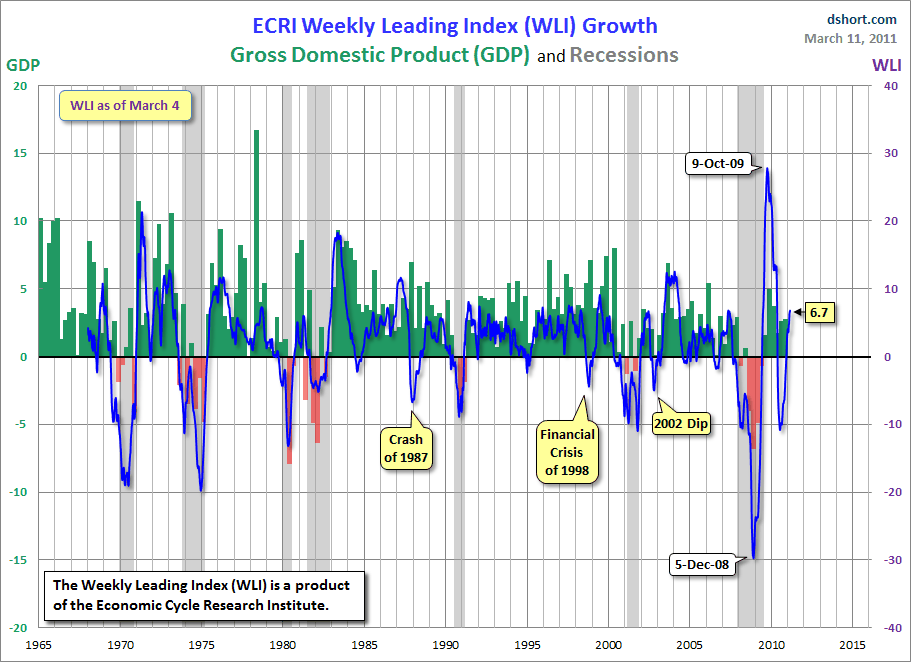
Complete Story » | | | | | | | | | | | | | | | | | | | | | | | | | Doug Short submits: The Weekly Leading Index (WLI) of the Economic Cycle Research Institute (ECRI) continues its rise. The Growth Index is now at 6.7 based on data through March 4. The Published Record The published ECRI WLI growth metric has had a respectable record for forecasting recessions and rebounds therefrom. The next chart shows the correlation between the WLI, GDP and recessions. A significant decline in the WLI has been a leading indicator for six of the seven recessions since the 1960s. It lagged one recession (1981-1982) by nine weeks. The WLI did turned negative 17 times when no recession followed, but 14 of those declines were only slightly negative (-0.1 to -2.4) and most of them reversed after relatively brief periods. Three other three negatives were deeper declines. The Crash of 1987 took the Index negative for 68 weeks with a trough of -6.8. The Financial Crisis of
Complete Story » | | | | | | | | | | | | | | | | | | | | | | | | | Trefis submits: Freeport McMoran Copper (FCX) is a miner of copper, gold and molybdenum. It has operations in North and South America, Indonesia and Africa, and competes with other miners such as the Southern Copper (SCCO), Codelco and Newmont Mining (NEM). The company derives the majority of its revenues from copper sales. Freeport started operations in Africa in 2009, and from 2009 to 2010, its copper sales increased from 130 million pounds to 262 million pounds. We expect production to increase as the plant hits full capacity. In addition, the market is speculating that Freeport will likely bid for acquiring Lundin Mining Corp (LUNMF.PK). If this deal goes through, this will give a boost to Freeport's revenues. While we anticipate the Freeport's copper sales from African operations will be rise to 790 million pounds by the end of our forecast period, Trefis members predict the sales will cross 860 million. We currently
Complete Story » | | | | | | | | | | | | | | | | | | | | | | | | | Hard Assets Investor submits: By Olivier Ludwig [This interview was previously published on IndexUniverse.com, and appears here with permission.] ETF Securities, a relative newcomer to the U.S. ETF market, has moved aggressively to market a broad array of precious metals ETFs targeting platinum, palladium, silver, gold as well as combinations of the four. In all, the company has seven U.S.-listed funds that have gathered $3.73 billion in assets — an impressive number considering its first U.S. ETF came to market in the summer of 2009. When IndexUniverse.com Managing Editor Olivier Ludwig caught up with ETFS' Chairman Graham Tuckwell on the sidelines of the "Inside ETFs" conference last week, they chatted about the value of different gold-vaulting locations and the company's plans to introduce physical industrial metals ETFs as well as a broad platform of futures-based commodities funds. Ludwig: Can you lay out the road map going forward of what you're up to in the
Complete Story » | | | | | | | | | | | | | | | | | | | | | | | | | Trefis submits: Salesforce.com (CRM) is a fast growing player in the cloud computing market that offers products such as cloud-based customer relationship management (CRM) software, Force.com, AppExchange and Database.com. The cloud-computing market is a fast growth area in which Salesforce.com competes with Oracle (ORCL), SAP (SAP), Google (GOOG), Microsoft (MSFT) and Amazon (AMZN). Below we take a look at Salesforce.com's historical spend on research and development (R&D), and consider how the outlook for this number could swing our $128 price estimate for Salesforce.com stock. Our price estimate is in-line with market price. Salesforce.com Continues to Innovate In addition to cloud-based CRM software, Salesforce.com has introduced quite a few innovative cloud-based products to the market in the last few years: - Force.com, a development platform for corporate IT departments and independent developers that allows them to build business applications.
- AppExchange, an online directory that provides customers a way to browse, test-drive, share and install
Complete Story » | | | | | | | | | | | | | | | | | | | | | | | | Eric Parnell submits: "To be interested in the changing seasons is a happier state of mind than to be hopelessly in love with spring." - George Santayana In my recent article entitled What to Expect from QE2's Pending Conclusion, I took a look at the risks facing the stock market if the Fed decides to follow through and end QE2 at the end of June. Whether the Fed will actually follow through with this commitment will remain a subject for debate in the next few months. But holding the Fed to its recent word, the time is now to look ahead and try to determine which investments might hold up best once QE2 is over. When the Fed ended QE1 in Spring 2010, the stock market immediately dropped -17% in a matter of weeks. Seeking to avoid this type of downside volatility post QE2 in the second half of 2011, I went searching
Complete Story » | | | | | | | | | | | | | | | | | | | | | | | | | Investment U submits: By Ryan Cole America's employment numbers are frustrating. One week, we see surprisingly good numbers. The next week, the figures are bad again. And some weeks, it's both – for example, when initial claims and ongoing unemployment don't seem to mesh. The markets are reacting to these swings with volatile fluctuations of their own. That makes sense, since the recovery depends on consumers really getting back on their feet and spending again. And many pundits think real estate won't truly bounce back until unemployment has dropped to a healthier 5%. The contradicting data begs the question if there's even a way to play this jobs market. Fortunately, the answer is a definite, resounding "Yes!" LinkedIn's IPO: A Strong Contender for Big Growth It's hard to say exactly when the jobs market will recover, but one thing we can be sure of: When it does, job brokers will have a field
Complete Story » | | | | | | | | | | | | | | | | | | | | | | | | | Steven Kiel submits: I caught an episode of Fast Money on CNBC Wednesday and Doug Kass mentioned that he liked a company called Platinum Underwriters Holdings (PTP). I admit I hadn't heard of the company before. He called it a special situation and likened it to Yahoo (YHOO). After researching the company I disagree with the Yahoo comparison, but I do think the stock is significantly undervalued and I'm very impressed by its management. The company has significant exposure to Japan and, consequently, shares have taken a beating today. We'll have to wait to see loss estimates, but this one time event doesn't change my thesis on the stock. Platinum Underwriters is a property and casualty insurer and also offers reinsurance coverage. Like most insurers, Platinum is trading at depressed valuations relative to its history. Investors in the industry remember getting crushed just a few short years ago and are hesitant to commit
Complete Story » | | | | | | | | | | | | | | | | | | | | | | | | | Mercenary Trader submits: By Jack Sparrow
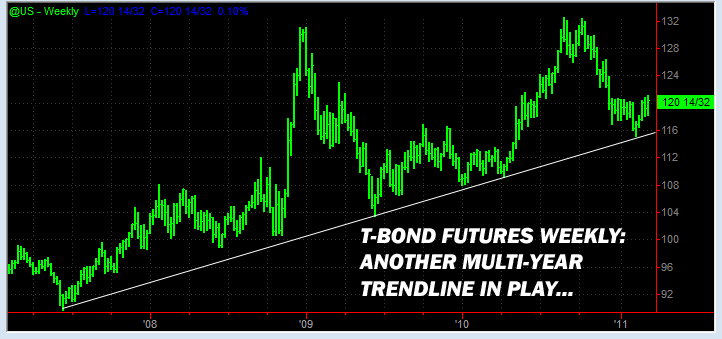
(Click to enlarge) In a very news-heavy week, a notable item was PIMCO's decision to purge U.S. government debt from its flagship fund. As Bloomberg reports, Bill Gross, who runs the world's biggest bond fund at Pacific Investment Management Co., eliminated government-related debt from his flagship fund last month as the U.S. projected record budget deficits. Pimco's $237 billion Total Return Fund last held zero government-related debt in January 2009 …
Gross, the original "bond king," has taken up the cause of the vigilantes in his monthly investment outlooks. He has warned repeatedly that debt levels are too high, and has openly wondered who will keep buying USTs when the Fed finally stops. Now PIMCO has put its money where its mouth is. But is this "alarming sign" (as many have deemed it) really a harbinger of looming armageddon for Treasuries? Or is it the mark of
Complete Story » | | | | | | | | | | | | | | | | | | | | | | | | | Sold At The Top submits: Today, the U.S. Census Bureau released its latest nominal read of retail sales, showing an increase of 1% since January and bringing the total increase since last year to 8.9% on an aggregate of all items, including food, fuel and healthcare services. Discretionary retail sales -- including home furnishings, home garden and building materials, consumer electronics and department store sales -- increased 0.66% from January, but climbed 3.45% above the level seen in February 2010 while, adjusting for inflation, "real" discretionary retail sales increased 1.81% over the same period. [Click all to enlarge]
On a "nominal" basis, there had appeared to be a rough correlation between strong home value appreciation and strong retail spending preceding the housing bust -- and an even stronger correlation when home values started to decline. The following chart shows the year-over-year change to nominal discretionary retail sales and the year-over-year change to
Complete Story » | | | | | | | | | | | | | | | | | | | | | | | | | Karl Denninger submits: The Fed Z1 came out yesterday to much lying in the mainstream media. Among the amusing tales of nonsense was this piece in The Wall Street Journal: But consumer debt, such as auto and student loans, has started growing again in recent months, suggesting that people might be getting in the mood to borrow again. No, it hasn't. The only place it has grown is student debt. I wrote on that the other day. The not-amusing part of this picture is that student loans, the only growing part, have been rendered non-dischargeable (except in extraordinary circumstances) in bankruptcy. The banks and schools (along with government) claim this is "necessary" since most students have little in the way of assets and would otherwise be judgment-proof. The obvious reply is that an education that can't be cash-financed by the student when he or she is graduating into an uncertain world with uncertain
Complete Story » | | | | | | | | | | | | | | | | | | | | | | | | | Felix Salmon submits: Should there be some kind of cap on director compensation? The question arises in Duff McDonald's Fortune profile of Rajat Gupta from October: His long career as a well-connected corporate consigliere made Gupta highly coveted as a director. Between 2006 and 2009, Gupta picked up seats on the boards of five public companies — American Airlines parent AMR, global outsourcer Genpact (of which he is also chairman), Goldman Sachs, audio equipment giant Harman International, and Procter & Gamble. He also joined the supervisory board of Russia's Sberbank and the board of the Qatar Financial Centre. Altogether, those positions paid him more than $3.2 million in 2009. Gupta has drawn criticism for his hefty board income. He left his position with Sberbank in June. But in 2008, he was paid $525,000 — more than he made for his Goldman board seat — to sit on the board of the bank, the
Complete Story » | | | | | | | | | | | | | | | | | | | | | | | | | Cliff Wachtel submits: The Euro is likely headed much lower in the coming weeks. Here are the 6 reasons why, & how to profit handsomely from the trend via forex binary options, standard spot forex, forex ETFs, stock indexes, and more. The Primary Two Driver's Behind The Euro's Rally Are Exhausted These were: - Rising optimism about growth (aka risk appetite). That is over as long as the Middle East/North Africa (MENA) region turmoil continues to raise doubts about oil supplies and sent oil prices spiking. Oil is up from $85 to around $105. It's widely believed that for every $10 increase in oil, GDP of oil importing nations (almost everyone) falls by at least 0.2%. With the EU, China, and much of the emerging market nations raising interest rates and cutting spending, growth was already expected to soften. Now there is greater risk of stagnation. The weaker peripheral economies were already stagnant, and
Complete Story » | | | | | | | | | |  | |  | |  |
 Hickey and Walters (



No comments:
Post a Comment